
Dradin, In Love first appeared in 1996, published as a standalone novella by Buzzcity Press. It would later become the opening movement of Jeff VanderMeer’s City of Saints and Madmen, the first volume in his Ambergris cycle of three novels. For this review, however, I return to the original novella form—a concentrated hundred-page tale—setting aside the later metafictional fireworks that surround it.
Jeff VanderMeer once told an interviewer how he discovered Ambergris: he woke in the middle of the night with an image of a missionary looking up at a woman in a third-story window. He immediately raced to his computer and began typing the first pages of Dradin, In Love—and the world of Ambergris grew up around that clear, intense vision. The only preparation for this memorable experience was VanderMeer telling himself that one day he would write about his best friend’s parents, who met when his father looked up and saw his mother in a third-story window, typing, and went up to ask her to marry him.
I relate this episode from VanderMeer’s life for a very specific reason: those first pages of Dradin, In Love possess an intensity, a drive, a propulsiveness that carries through to the tale’s dramatic end. We witness Dradin, a thirty-year-old missionary who has just returned from seven years in the jungle—forced back after a bout of jungle fever—looking up through a third-story window at a fair-skinned woman sitting at a desk, typing, with her seraphim-blue eyes and long, flowing black hair. He immediately falls deeply in love, and from that moment onward, his passion is mixed with obsession and a touch of madness.
However, much of the novella’s power—and its lush, dusky, baroque beauty—derives from more than the unfolding events surrounding Dradin. It springs instead from the author’s stunning world-building, his first strokes in shaping Ambergris. What I find most uncanny (and appealing) is the way VanderMeer prompts the reader to engage their imagination and become a co-creator, piecing together fragments from the Victorian, the modern, and the fantastic. Nothing is fixed; nothing is solid. Unlike Jeff Noon’s Nyquist novels (set in the 1950s) or M. John Harrison’s Viriconium (set in the distant future), VanderMeer refuses even to provide a clear chronology.
Ah yes—the world of Ambergris counts for so much. To share a taste, consider the following:
Unique Mix – Dradin takes a horse-drawn carriage because “he could never have afforded a mechanized horse, a vehicle of smoke and oil.” If this sounds like another steampunk novel, think again—in the next few pages Dradin enters the Borges Bookshop on Ambergris’s main avenue. Later, walking down a crowded city street, he has to sidestep “an Occidental woman.” Where on the map are we? Istanbul, perhaps? No—Ambergris lies five hundred miles north of a jungle! With all these details, including Dradin overhearing a woman playing Vos Bender’s Fifth (echoes of a famous piece of classical music), we as readers would do well to remember that VanderMeer has created a city and a world entirely his own.
Destabilize and Foil Expectations – Once inside Borges Bookstore, in the “Objects of Desire” section, a clerk hands Dradin a book bound in soft velvet and gold leaf, entitled The Refraction of Light in a Prison, the “collected wisdom of the last of the Truffidian monks imprisoned in the Kalif’s dark towers.” We recognize the Kalif as Muslim (a real-world reference), but the Truffidian monks are pure invention. And if anyone assumes Dradin is a Christian missionary in any recognizable sense, we need only recall the old teacher he visits: “a studded dog collar circled his withered neck,” and he considers it perfectly acceptable for a stark-naked man to masturbate in the school garden—a man the teacher insists is a living saint, a professional holy man. Goodness. Nothing at all like Catholicism as we know it today.
Beyond Law & Order – Does Ambergris sound like an interesting place to visit? Dradin refers to “lawless Ambergris”—and for good reason. The city’s largest importer and exporter specializes in depravities for the amusement of the decadent. After a famous city festival, our lovesick missionary observes: “The same languid, nostalgic streets of daylight had become killing grounds, a thousand steely-eyed murderers hiding amongst the vetch and honeysuckle.” As for street entertainment, we read: “On the fringe, jesters pricked and pranced, jugglers plied their trade with babies and knives (mixing the two as casually as one might mix apples and oranges).” Ah, what an outrage! Would you still care to visit this fair city? Not me—I’ll stick to my reading chair, VanderMeer’s novella in hand, thank you.
Architecture at Sixes and Sevens – The very physicality of VanderMeer’s Ambergris underscores his refusal to be pinned down or pigeonholed into any category or genre. “Dradin wandered into the religious quarter, known by the common moniker of Pejora’s Folly after Midan Pejora, the principal early architect, to whose credit or discredit could be placed the slanted walls, the jumble of Occidental and accidental, northern and southern, baroque and pure jungle, styles. Buildings battled for breath and space like centuries-slow soldiers in brick-to-brick combat. To look into the revolving spin of a kaleidoscope while heavily intoxicated, Dradin thought, would not be half so bad.”
Mushroom Dwellers – The size of a small, squat child, with long necks and large hands, these beings—also called “grey caps” for their ashen hue—are neither quite human nor fully other. Gnome-like, the nocturnal, fungus-harvesting mushroom dwellers live in tunnels and subterranean caves, embodying a city with a deeply disturbed ecology. They are the one fantastical element in VanderMeer’s creation that otherwise follows the laws of nature.
I dare anyone to read Dradin, In Love and not be excited to move on to the astonishing worlds of City of Saints and Madmen, Shriek: An Afterword, and Finch. Jeff VanderMeer—to set your imagination aflame.
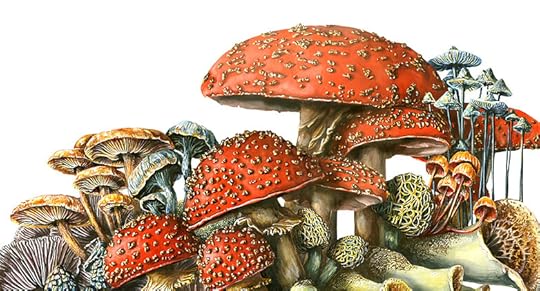
"Certainly the jungle had never concealed such a cornucopia of assorted fungus, for between patches of stone burned black Dradin now espied rich clusters of mushrooms in as many colors as there were beggars on Albumuth Boulevard: emerald, magenta, ruby, sapphire, plain brown, royal purple, corpse white. They ranged in size from a thimble to an obese eunuch's belly."

American author Jeff VanderMeer, born 1968
Comments
Post a Comment