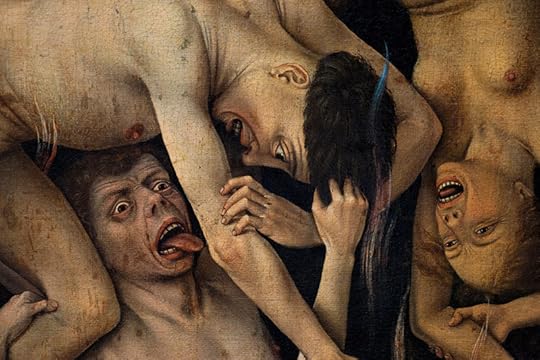
If there ever was an author who could write cogently about three people crammed into a tight space, it is Michael S. A. Graziano. After all, with his background in psychology and neuroscience, he has conducted extensive research on how the brain’s system for maintaining personal space—an invisible safety zone—constitutes a fundamental part of human nature, the central topic of his book The Space Between Us.
The Divine Farce is the author’s short novel in three parts: (1) the narrator, along with a woman and a man, crammed into a tight space; (2) the trio breaking free and the narrator squeezing through a labyrinth of caverns amid thousands of naked bodies; and (3) the narrator, in isolation, moving atop the enclosed labyrinthine structure. Is this a kind of hell, similar in many ways to A Short Stay in Hell by Steven L. Peck? The narrator, a chap calling himself Brother Brian Blue, certainly thinks so.
“We were in darkness. It was our home. The vertical, cylindrical hollow was about two feet in diameter—tight for three adults, just large enough for us to breathe up against each other or to shuffle slowly in a bumping, awkward revolution.”
So begins this incredibly compelling tale. A few personal observations. I'm claustrophobic. Thus, I couldn't imagine a less appealing space to be entrapped. Actually, I could. If instead of “a mumbling garble of sound” this cramped space had piped in Muzak, I would quickly go crazy. Also, narrator Brian Blue doesn't mention having to deal with insects. Since I'm allergic to insect bites, dealing with chigger bites, bee bites, wasp bites, or any other type of bites would intensify this hell immeasurably.
If I had to endure such a tiny space with two other naked people and was given three wishes, here they are: (1) I would ask for a shower fixture with soap since I hate feeling dirty. Brian Blue and the others remain filthy dirty and stink. Just reflecting on such an abysmal physical state turns my stomach. (2) I would also ask for a muted yellow light in the ceiling to at least share some degree of vision with my two companions. (3) Lastly, being a typical macho guy, I would ask for two pleasant, attractive, healthy ladies to share this tiny space.
I mention the above for a good reason: at every stage in Graziano's novella, we as readers will naturally ask ourselves what we would do if faced with such diabolical challenges.
“We had no mutual barriers. At first we might have resented physical intrusion, but let a week pass, let a year pass, let moments trickle into moments until the concept of the temporal increment is entirely lost—and psychological barriers dissolve in the lukewarm pear nectar. Taboos fall and liberties become ordinary. Touch replaces vision.”
Here Graziano draws on his research in psychology. Crammed into such a tight space, the natural “invisible safety zone” each individual constructs has disappeared, and, on a profound level, the three bodies have become one. Touch is now the king and as long as touching remains pleasant, there are no restrictions. “Sex helped us to achieve a single warm blend. It was emotional nectar, and we maintained ourselves on a regular diet of it.”
“Talking is what kept us sane, if that is what we were. . . . “It isn't heaven, it isn't hell, it's simply where we are, and it stinks. It stinks literally. It stinks and it hurts. And the people here are driving me crazy.”
We believe you Brian Blue! Even if I was granted my three wishes, I'm not naïve. Any three people wedged into an inhumanly restricted space will, given time, drive one another insane.
When the trio breaks out of their cell and land in an endless labyrinth--corridor after corridor after corridor of thousands of naked women and men--the narrator quickly loses contact with the pair he's spent what feels like a lifetime with. From this point forward, it's Brian Blue going solo.
I had to ask myself, faced with this stinking labyrinth and crushing crowds where life is reduced to sheer survival, what would I do? I know, I know--it might appear I'm taking the high road, but I think I would find a quiet corner of a small cave (such caves exist, so Brian Blue tells us), sit down, and begin meditating. And remain in meditation as long as humanly possible.
What would you do? I urge you to pick up The Divine Farce and reflect on this question as you turn the pages.

American author and neuroscientist Michael S.A. Graziano, born 1967
Comments
Post a Comment