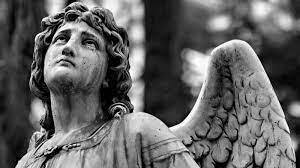
MRS. RINALDI'S ANGEL by Thomas Ligotti
“From time to time during my childhood, the striking dreams that I nightly experienced would become brutally vivid, causing me to awake screaming.” So begins this beguiling, quizzical tale of terror where only one thing is certain: Thomas Ligotti leaves enough room for each reader to reach their own conclusions.
I'll give the tale's unnamed teenage narrator a name – Quinn. Now that he's done shouting and is completely awake, Quinn tells us he sinks back into his bed, exhausted. However, by Quinn's judgement, he's compensated for being physically drained: “the awful opulence of the dream, a rich and swollen world nourished by the exhaustion of the flesh. The world, in fact, as such. Any other realm seemed an absence by comparison, at best a chasm in the fertile graveyard of life.”
Such a curious statement coming from young Quinn: the world of dreams counts as the rich core of life rendering our everyday waking reality a pale shadow.
And what do Quinn's parents think of Quinn's waking from a dream screaming, something he's been doing for some time now? Predictably, echoing the values of modern day society when an individual deviates from the conventional, routinized, commonly accepted worldview: of course, Quinn needs to see a doctor. However, unlike his father, Quinn's mother has had some of her own brushings with the dreamworld and seeks out a woman she knows who might help Quinn via nontraditional means.
Fast forward - Quinn sits in the living room of a Mrs. Rinaldi. After describing the room for us in detail, Quinn reflects, “How well I knew such surroundings, those deep interiors of dream where everything is saturated with unreality and more or less dissolves under a direct gaze. I could tell how neatly this particular interior was arranged - pictures perfectly straight and tight against the walls, well-dusted figurines arranged along open shelves, lace-fringed table covers set precisely in place, and delicate silk flowers in slim vases of colored glass. Yet there was something so fragile about the balance of these things, as if they were all susceptible to sudden derangement should there be some upset, no matter how subtle, in the secret system which held them together. This volatility seemed to extend to Mrs. Rinaldi herself, though in fact she may have been its source.”
Thomas Ligotti packs in so much content
here. Two things to keep in mind when reading this
passage: firstly, the exactitude of language. Although there's much
rococo flourish in the description, Ligotti writes in a way where
every single word counts. Secondly, Quinn appears to see two forces
at play in both Mrs. Rinaldi herself as well as her living room: the fragile outer
shell and a deep, dark, chaotic inner reality held in check
but forever at the ready to erupt.
On closer examination, Quinn recognizes Mrs. Rinaldi represents an old woman from the peasant race. Indeed, her accent, the way she dresses, her manner, her eyes, her complexion and hair all speak to the archaic traditions of alchemy and magic. After Quinn's mother explains the reason for their visit, Mrs. Rinaldi replies: "Missus," she said to my mother, though her eyes were on me, "I would like to take your son into another room in this house. There I believe I may begin to help him."
Quinn's mother agrees. When Mrs. Rinaldi has Quinn alone, we read: "Do you know what dreams are?" she asked quietly, and then immediately began to answer her own question. "They are parasites-maggots of the mind and soul, feeding on the mind and soul as ordinary maggots feed on the body. And their feeding on the mind and soul in turn gnaws away at the body, which in turn again affects the mind and the soul, and so on until death.” Mrs. Rinaldi continues, filling in much detail. Here are several snips: “Little by little, night after night, they take us away from ourselves and from the truth of things. I myself know very well what this can be like and what the dreams can do to us. They make us dance to their strange illusions until we are too exhausted to live. And they have found in you, child, an easy partner for their horrible dancing....They corrupt us in every way, abducting us from the ranks of angels we might have been or become, pure and calm and everlasting.”
The room is made dark and Mrs. Rinaldi instructs Quinn to perform a series of ritual actions and when Quinn is on his knees Mrs. Rinaldi slowly lifts the lid of a long low box from which luminousness emanates. When the lid is opened wide, the light grows into a pale brilliance that seems confined wholly within the box itself. Mrs. Rinaldi gives Quinn further instruction and the ritual with the light continues and then, moments later, comes to a close.
Before leaving her house, Mrs. Rinaldi tells Quinn, "You will feel better now, but never try to guess what is in that box. Never seek to know more about it." Thereafter Quinn does, in fact, experience a release from the terror of dreams...for a time. What exactly happens is for each reader to discover.
Mrs. Rinaldi's Angel raises a number of provocative questions, among their number expressed in brief:
Cosmic Horror – When Mrs. Rinaldi explains how dreams are “parasites-maggots of the mind and soul, feeding on the mind and soul” is such diabolical destruction just one aspect of a malignant, horrific universe we humans are trapped in? In one of his essays, Thomas Ligotti himself alludes to "the fiasco and nightmare of existence, the particular fiasco and nightmare of human existence, the sense that people are puppets of powers they cannot comprehend.”
Cosmic Dualism – Rather, are Mrs. Rinaldi's words about dreams addressing cosmic dualism, that is, a universe where two equally powerful forces, light and darkness, good and evil, purity and the defiled continually wage war against one another where the prime battleground is the human mind, heart and soul? Such a worldview was fundamental to the ancient religions of Zoroastrianism, Manichaeism and some forms of Gnosticism.
Bliss
and Ecstasy – Enlightenment traditions such as those found in Tibetan
Buddhism and many schools of yoga view the pure, unstained, clear
light of consciousness as the ultimate substratum,the supreme
reality. Can such a philosophy be in any way compatible with what
Mrs. Rinaldi posits?
Nature of Dreams – For anyone familiar with Dream Yoga, Lucid Dreaming or the Jungian approach to dreams as a vital step in a person's reaching individuation, Mrs. Rinaldi's words will shock. Could Quinn possibly reach a point where he could use his disturbing dreams as powerful tools to enhance his own self discovery and personal growth?
Arts and Literature – Does Mrs. Rinaldi's view of dreams overlook their creative side? Think of all the writers and artists who have used dreams as vehicles for their creations. What would the art of the Surrealists such as Leonora Carrington, Max Ernst and Salvador Dali look like devoid of the power of dreams?
Note: You can read and listen to this Thomas Ligotti tale via a simple Google search.

Thomas Ligotti, born 1953
Comments
Post a Comment