A Certain Gesture: Evnine’s Batman Meme Project and Its Parerga! Volume One by Simon J. Evnine (Editor)
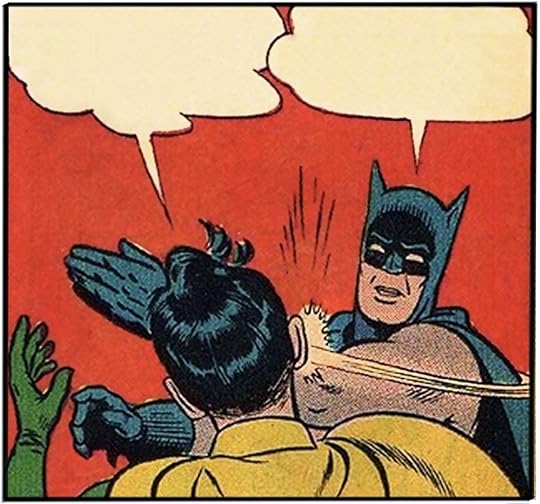
Take
a look at the above image. What did Robin say to prompt Batman to slap
him? Or, just maybe, it was something Robin did to provoke Batman's
violence. The possibilities are endless.
Actually, in Simon J.
Evnine's book, we're given more than four dozen variations on this
cartoon frame, with all sorts of interesting captions/additional
wording/image modifications. Interested? I hope so since Simon
underscores how a reader should have FUN. That certainly was my
experience. And I say this as a non-specialist in philosophy,
psychoanalysis or Judaism (more below on this point).
First off, let's take a look at the book's title page:
A Certain Gesture: Evnine’s Batman Meme Project and Its Parerga! Volume One Edited by Simon J. Evnine
You gotta love how Simon injects elements of humor. Volume One
is over 300 pages! Obviously his subject is so rich it can be expanded
to more volumes. Hey, why not? Also, indicating he's the editor rather
than the author, although he wrote the entire work, start to finish. And
ending with an exclamation point to emphasize the dynamism of the book.
Sidebar: throughout the book Simon speaks of himself in the
third-person.
By the way, two dictionary definitions are in order:
Meme
- an image, video, piece of text, etc., typically humorous in nature,
that is copied and spread rapidly by internet users, often with slight
variations
Parerga - a piece of work that is supplementary to or a byproduct of a larger work
Got
that? Well, in the spirit of accommodating a reader, Simon made four
short videos addressing his vision for the book. Here's a quick
summation:
The book, so Simon informs us, consists of
commentaries of memes he made with the image of Batman slapping Robin,
written as if by an editor who is distinct from the maker of the memes.
These commentaries are about, among other things, philosophy,
psychoanalysis and Judaism.
Overall, the book is a work of
philosophy, both premodern and postmodern in inspiration. His book does
not have a unified voice, is not about anything in particular, does not
take a position on any controlling idea nor does it have a thesis.
However,
Simon insists, it is a work of philosophy since it has philosophy in it
– an exposition of interesting ideas for the non-specialist (people
like me) along with the development of original ideas. All materials
have been generated in the form of presentations, blogs and videos. The
book investigates what are the boundaries of a work and how fragments
can compose a work without ceasing to be fragments. The book challenges
what we can expect from philosophy; the book is a work OF but NOT ABOUT
metaphilosophy. Lastly, two aspects deserve their own call out:
Autotheory
– This links discussions of impersonal topics with events and feelings
in Simon's own life. For example, a lot of the book is about the emotion
of shame, some in the form of an interaction with moral psychologists
who write on the subject. But shame is an emotion that has dominated
Simon's life and moments of Simon's shame crop up throughout the book.
The image of Batman slapping Robin is intimately connected to shame. But
Simon has felt very ambivalent about appropriating the concept of
autotheory in light of how autotheory has been employed by minority
groups toward institutions that have been oppressive to them.
Psychoanalysis
- The writing of Simon's book about memes and what surrounds memes took
place during his own sessions of psychoanalysis. Thus the image of
Batman slapping Robin became intertwined with his very personal
experience of psychoanalysis, an image that was deep in Simon's psyche
and came to occupy a larger place in Simon's own internal sadomasochism –
his older self vs. his younger self. Additionally, Simon wanted to
describe what it is like to be in analysis. The book contains instances
of free association, something that has been very hard for Simon in his
undergoing psychoanalysis but seemed to come easily in his writing the
book. Finally, we have what Simon terms “paratext”. It wasn't easy for
Simon to distinguish what was the book and what was supplementary to the
book. One of the tasks of analysis is to deal with and manage
intrusions of reality into the fantasized space of the analysis.
I
could cite dozens of quotes from the book that I found fascinating and
prompted my own philosophic reflections. But since I'm writing a book
review and not a book, I'll share just one in the hope that you'll give
Simon's book a whirl:
“Clear writing, too, is aggressive and
sadistic - not in its content but in the domination it attempts. The
reader is ‘forced’ to look here and not there (where their own
phantasies might take them), to disregard this but to give that a lot of
weight, to understand something polysemous in one way and not another."
Hmm.
This give me pause since I attempt to be clear when I write. Am I being
aggressive and sadistic in any way? I wonder. But one thing appears
certain - a meme or image can be aggressive in its forcing a
viewer/reader to one definite interpretation. Take the below image as an
example. Since we are viewing comic book characters, how much latitude
does a viewer have for interpretation? And the words in the captions are
rather one-pointed and aggressive. Any thoughts?
Thanks, Simon! 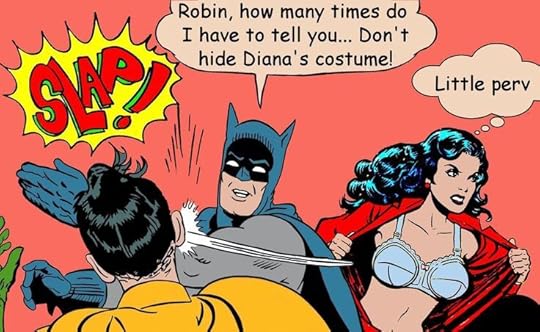

British author/scholar Simon J. Evnine, currently a philosophy professor at the University of Miami in Florida.
Comments
Post a Comment