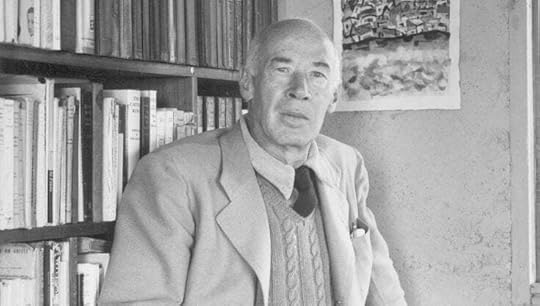
Sexus, Henry Miller's first novel in his Rosy Crucifixion trilogy, is a fictionalized autobiographical account written when Miller was in his fifties, reflecting on his time as a thirty-something in New York City before his Paris years. Miller doesn’t hold back—everyday life, philosophical musings, and sex, along with more sex, erupt in a 500-page literary volcano that was famously banned from publication in the US.
As a way of providing something of a taste test for this Henry Miller rosy crackerjack, below are a number of Sexus direct quotes along with my comments.
“We got into a cab and, as if wheeled around, Mara impulsively climbed over me and straddled me. We went into a blind fuck, with the cab lurching and careening, our teeth knocking, tongue bitten, and the juice pouring from her like hot soup.”
Can you imagine a prudish, puritanical judge back in 1940s America reading these lines? We shouldn't be surprised the publisher was fined and handed a prison sentence. Fortunately, some years later, readers could detect there was more to Sexus than sex, that the novel possessed the qualities of a first-rate literary work.
“The only benefit, I reflected, which the act of writing could offer me was to remove the differences which separated me from my fellow man. I definitely did not want to become an artist, in the sense of becoming something strange, something apart and out of the current of life.”
Henry Miller leaves no doubt: while his voice as a writer—his particular angle of vision—counts as his exclusive, unique property, he always aimed for his writing and life as a writer to express a common human experience that all women and men could directly relate to. Miller positions himself at the opposite end of the artistic spectrum from those writers and artists, like the nineteenth-century French decadents, who viewed themselves as highly refined, uniquely aesthetic beings, holding little in common with the vast majority of the population they looked down upon as a filthy, money-grubbing ruck.
“A great work of art, if it accomplishes anything, serves to remind us, or let us say to set us dreaming, of all that is fluid and intangible. Which is to say, the universe. It cannot be understood; it can only be accepted or rejected. If accepted we are revitalized; if rejected, we are diminished.”
Henry Miller understood that no amount of analysis, commentary, or theory could ever fully capture the essence of a true work of art. His words remind us that art defies containment; it invites us to encounter it without preconceptions, to let it wash over us like a mystery we accept rather than solve. To engage with a work of art—especially literature, one of the most vivid expressions of the human spirit—demands a willingness to be transformed. In that openness, Miller suggests, lies the potential for revitalization, a renewal that only those who surrender themselves fully can experience.
“The only time a writer receives his due reward is when someone comes to him burning with this flame which he fanned in a moment of solitude. Honest criticism means nothing: what one wants is unrestrained passion, fire for fire.”
Having spent the past twelve years immersed in writing book reviews, Henry Miller's words resonate deeply with me. My goal has always been to go beyond mere critique, to share the author's vision, and ignite in others the same fervor I feel. I want to convey not just why a book is worth reading, but why missing it would be a kind of loss.
“To be joyous is to be a madman in a world of sad ghosts.”
Reading Miller's works—books like Tropic of Cancer, Big Sur and the Oranges of Hieronymus Bosch, and the novel under review—it becomes clear that Henry Miller is all about celebrating life. Even when his head and bones ache, or when he's hungover and feeling exhausted from a marathon conversation with friends or an intimate night with a lover, Miller still makes room for joy, for the simple fact that he's alive.
“People have had enough of plot and character. Plot and character don't make life. Life isn't the upper storey: life is here now, any time you say the word, any time you let rip. Life is four hundred and forty horsepower in a two-cylinder engine . . .”
Here, Miller lashes out at anyone who clings to the notion that a novel must mimic the style of Charles Dickens or Theodore Dreiser. No! Henry Miller knew, deep in his heart and gut, that his writing—raw, revolutionary, and wildly unorthodox—was as legitimate as any novel that had come before.
I've only touched on a few highlights. Again, Sexus is a 500-pager. More, much more Henry Miller burning lava awaits a reader courageous enough to tackle this glowing gem.
Comments
Post a Comment