Like most young students in the U.S., I read in my history books that, beginning in the early 1500s, the conquistadors landed in the New World and conquered the Aztecs, the Mayans, and the Incas. Other than noting the recent arrival of diseases like smallpox wiped out huge swaths of the native population, not much detail was provided. Thus, José Ángel Mañas’s novel, based on actual historical facts, proves to be an eye-opener. Here we have the story of a Spanish Christian named Gonzalo Guerrero, who lived among the Mayans for more than twenty years.
In sixty-three short, lucid chapters, we're given a rip-roaring tale of adventure. Special thanks to Brendan Riley for his translation into clear, accessible English. As we turn the pages, moving from chapter to chapter, we share in Guerrero's gripping odyssey.
It all began in 1512 with Vasco Núñez de Balboa’s ambition to conquer a vast and mysterious empire to the west. At the time, the future great conquistador governed the small Spanish coastal settlement of Santa María la Antigua del Darién, in what is now Colombia. Seeking support from Diego de Colón—Viceroy of Hispaniola, Admiral of the Indies, and eldest son of Christopher Columbus—Balboa sent a ship loaded with gold seized from the nearby Indians, commanded by Captain Juan de Valdivia, to the viceroy’s headquarters in what is now the Dominican Republic.
However, things didn't go according to plan. On the second day of their voyage, a violent gale overwhelmed the ship and intensified over the next seven days, until—far off course—the keel struck the rocky shallows of the Viper Shoals near Jamaica, leaving the vessel in tatters. Captain Valdivia was forced to unlash a skiff and set off with as many souls as the small boat could hold—among them, Gonzalo Guerrero. All twenty aboard watched as their ship finally sank, taking with it all the gold and dozens of chained Indian slaves in the hold. Then the currents swept their skiff out to the open sea, as the captain and everyone else realized that, although they had survived the devastation, they were left with no food or water.
For nearly two weeks, all aboard “suffered an agonizing thirst and a blazing sun that roasted their innards, clinging to life as best they could upon an increasingly flimsy skiff that was falling to pieces.” A good number died of sunstroke or thirst and were dropped overboard. Then, finally—finally—the coastline of an unknown land appeared. In a state of rapture, grabbing hold of the planks they’d been using for oars, the remaining survivors paddled to the beach.
After quenching their thirst with water from coconuts and satisfying their hunger by eating shellfish and cooking sea turtles, that night everyone stretched out around their bonfire for a well-deserved rest. But any break in their suffering would prove short-lived. That very night, the Europeans were surrounded by Indians “wearing feathered headdresses, their faces coated with red ocher. Many of them had their cheeks or lower lips pierced, each small hole braided with fine strands of bamboo.” Little did Guerrero and the others know—they were now in the lands of the Mayan civilization, in the Yucatán Peninsula of present-day southeastern Mexico.
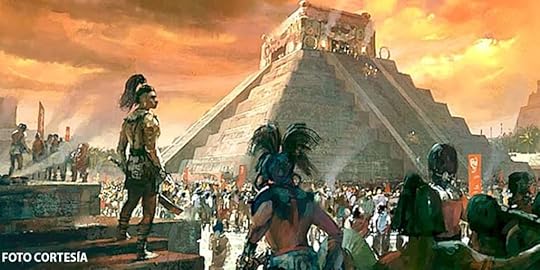
These Mayans are the Cocomes and they march the Europeans single file through the jungle to their primitive city where, in the center of the great plaza, a towering pyramid looms. “The great structure must have measured at least one hundred feet wide. The side facing them had a steep staircase with very tall, broad steps that ascended to the different levels, each one occupying an area slightly smaller than the one below it, up to the highest level, where two smoking braziers stood before the temple.”
It’s clear that José Ángel Mañas conducted extensive research on the ancient Mayan civilization. We’re given vivid details about their dress and diet, their customs, rituals, and way of life. You’ll have to read this compelling novel to find out how Guerrero and the others fare—and how the Europeans ultimately end up in the hands of the more powerful Mayan group, the Tutul Xiu. What I can say is that Guerrero proves to be a valuable asset to the Tutul Xiu. Drawing on his extensive military experience, he trains their warriors in the strategies and techniques of European warfare.
Toward the end of the novel (a short novel that can be read in a day or two), we encounter a dramatic scene between Guerrero and Aguilar, a Catholic priest who was one of the ship’s survivors and, like Guerrero, has lived among the Mayans all these years. However, Aguilar has staunchly maintained his Christian faith and gained the Mayans’ respect by consistently refusing the company of women.
Alas, the dramatic scene revolves around the time when both men are given a choice: remain among the Mayans or return to Spain. Without hesitation, Aguilar chooses to return to his own people. Not so with Guerrero. Aguilar pleads with him, finally asking, “Disowning your people is one thing, but have you also disavowed Christ? Do you really believe in their idols?”
To this, Guerrero replies, “What I believe is that the Mayans need them—that they are the heart of their culture. And, if needed, I will defend those gods from Christian aggression. They form part of the roots these people must never lose.”
José Ángel Mañas has written a novel deserving a wide readership. Again, a true eye-opener.

Spanish author José Ángel Mañas, born 1971
Comments
Post a Comment