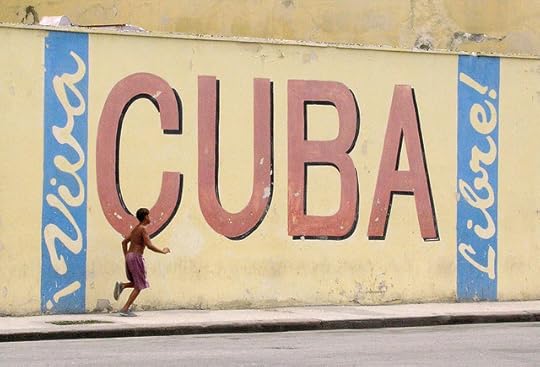
Viva, Cuba! Soursops, pineapples, star apples, mammees, anonas, icaco plums, guavas, cassava, peppers and wild malanga, anyone? If you like your dishes and literature spicy and tangy, you’ve come to the right place. This outstanding collection of Cuban fiction features short stories from thirteen authors, including Jacqueline Herranz Brooks, Angel Santiesteban Prats, Arturo Arango, Marilyn Bobes, Leonardo Padura Fuentes, Miguel Mejides, Reinaldo Arenas, Miguel Barnet, Lourdes Casal and Alejo Carpentier. To share some Cuban spice, here are a number stories with my one-line or two-line blurbs coupled with a direct quote. And below these, the first several paragraphs of a true classic (translated into English for the very first time) by Virgilio Piñera:
13TH PARALLEL SOUTH by Angel Santiesteban Prats
We enter the mindstream of a revolutionary infantryman trudging along a remote jungle path with his unit in search of some house or town where they can put their hands on much needed medical supplies. Turns out, one of the soldiers is more interested in playing his violin than in fighting. “The cook says that the violinist eats only proper food and with a napkin, that’s why he doesn’t touch this food and why he looks the way he does; jaundiced, and so skinny – just glasses and a violin.”
TEN YEARS LATER by Marilyn Bobes
A striking Cuban feminist voice: "That night in the hotel, she'd hardly had time to fantasize herself entwined around the statue's narrow pelvis (Bebo's agile, snaky playful hips), when Jacques came, as always , only a few seconds after he'd begun to penetrate her."

Marilyn Bobes (Born 1955)
AN UNEXPECTED INTERLUDE BETWEEN TWO CHARACTERS by Jacqueline Herranz Brooks
With this short story the author captures much of the explosion in cultural frontiers beginning in the 1990s on the island. Many writers, particularly the younger generation, write stories where sex - gay, lesbian, heterosexual - along with drugs and the movie theater craze figure prominently, as per this slice of action: “Feeling each other up hasn’t been comfortable. Because they both have zippers and shoes, and the narrow seats with hard wooden arms hem in their contours. On the screen, bats are screeching and blood is flying in all directions, and the actors, carrying out violent acts, exchange laughter of panic and terror. Asminia moans softly, and the one with the dark skin, as it’s called here, also moans, and probably a few other people in the movie theater moan or feel each other up, seeing that two girls – one of them looks drugged – are pressing up against each other in the discomfort of the movie theater seats.”
SOMETHING IS HAPPENING ON THE TOP FLOOR by Reinaldo Arenas
A family man, emotionally shattered to the core, undergoes a serious identity crisis as he hangs over his balcony on the top floor of a city apartment building. “There were voices rising from the street, and the drone of motors, unintelligible conversations, vituperations, shrieks, music that was not music but clatter adding to total disharmony, fragmented echoes of marches and demonstrations, gibberish, and whistles . . . But all that cacophony gradually faded as it passed the lower floors, so that on the top terrace, where he was, only the reverberations from a truly extraordinary noise could reach him, which never happened . . . A bird was singing, perched on the telegraph or telephone wires or electrical cables.”
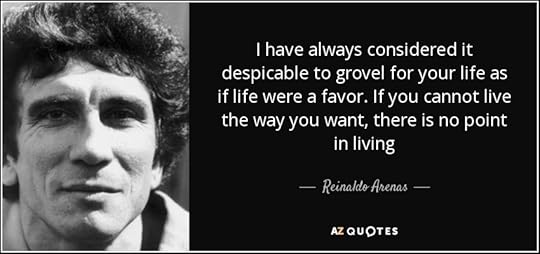
Reinaldo Arenas (1943-1990)
A LOVE STORY ACCORDING TO CYRANO PRUFROCK by Lourdes Casal
“You’ll either experience my writing as the purity of speechlessness (or at least fidelity to Havana Spanish) or feel as if I’m navigating through multiple tongues, all literal descendants of the grand Miguel – not our beloved radio host Miguel Villalobos, but the other: Cervantes, whose language cannot be swallowed in tidbits.” So declares the narrator/writer on her novel-in-the-making, her own rendition of the spirit of Cuba a la Cabrera Infante’s Three Trapped Tigers as she looks over the Hudson River from New York, reflecting back with nastalgia on the beauty of her beloved Cuban beaches. She continues: “I told you life is an excuse to write.”
CURRICULUM CUBENESE (from Cuba With A Song) by Severo Sarduy
Severo Sarduy’s first words: “Feathers, yes, lovely brimstone feathers, heads of marble carried down a river of feathers, feathers on her head, a feather, hummingbird, and raspberry hat in fact, from which Help’s smooth orange nylon hair stretched to the ground, braided with pink ribbons and little bells; from her hat the albino locks cascade down the sides of her face, then hips, down her zebra-skin boots to the pavement. And Help, in stripes, an Indian bird behind falling rain.” We are treated to a tale of festival, carnival, Mardi Gras – Cuban-style. Celebrar!
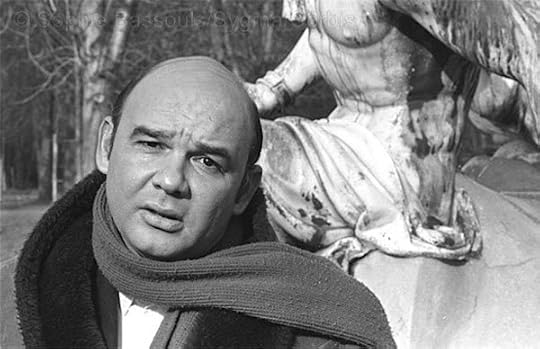
Severo Sarduy (1937-1993)
LITTLE POISONS by Sonia Rivera-Valdés
From a recent newspaper article: "Sonia Rivera-Valdés, accomplished Cuban-born lesbian author, professor, and president of The Latino Artists Roundtable, introduced the Second International Congress of Latino Artists, “Multiple Realities, Multiple Fictions,” to an enthusiastic group at New York University." She currently lives in New York City and, along with her teaching and fiction writing, is a literary and art critic. From her story: "Believe me, that was my saddest night. That jealousy was a thousand times worse than the one I felt knowing he shared kisses and caresses: it had been years since the bond that held us together was not love but fright."

Sonia Rivera-Valdés (Born 1937)
THE GREAT BARO by Virgilio Piñera
The Great Baro, the revolutionary clown, made his debut that night. And we say he debuted because until then he had never performed before any audience whatsoever. It is true, the circus owner found him in the last place you would expect to find someone clowning around – that is, at a burial. There, mourning the passage of a beloved friend, was the man whose misfortune it would be to be transformed overnight into the Great Baro.
The circus owner got it into his head that this man, drowning in tears, choked with emotion, lugubrious looking, dressed in black, staring into the grave, was the clown he had been searching for to open his circus this season.
Of course he was mistaken. The man hadn’t even gotten close to being a clown in his entire life. He was nothing but an obscure employee in a ministry. He was about fifty, with no ideas, plenty of hunger, no one who loved him, today the same as yesterday and tomorrow. Now and then a funeral. His obscure friends told him he did it well and even congratulated him on it.
As you can see, he was altogether dark and somber. From one sunrise to the next, he spent his obscure life in mourning. So what humor, what clownishness could there be in such a worm? Well, that which the boss of the circus believed he saw. Or more likely, he didn’t even believe it but leaped into the arms of absurdity. In any case, what is certain is that he followed Baro all the way home, belaboring him with promises of great triumphs and great earnings.
“I know,” Baro responded, “You want me to play the clown.”
Deep in thought, he looked intently at the circus owner and, very politely, added:
“I have never tried to make a clown of myself, but as you insist, I’ll give it a try.”
And he continued deep in thought – so much so that his interlocutor, who was already rubbing his hands together, success in sight, grew alarmed. Grabbing Baro by the shoulders, he said:
“Hey! Don’t assume it’s going to be so hard. Besides, a great tradition exists . . . “
“But with my face . . . Do you think I’m going to be any different in the ring than I am at a funeral? I’m afraid . . . “
“What are you afraid of?” The circus owner interrupted. “Are you afraid of cat calls from the audience? As for that, rest assured you are the most laughable person I’ve seen in my many years as a clown scout. You don’t know it, but I’m telling you the truth, my friend, I have discovered you and I expect the audience to applaud my discovery.”
Baro was thunderstruck: he was already opening his mouth to object. His visitor didn’t give him time. In a soothing voice, he said, “We have to give you a nice clown name. Yes, right this minute. You will be called Baro, the Great Baro, the One and Only Baro, he who knocks them dead with laughter. . .”
“Or with sobbing,” replied Baro. “It isn’t an objection, but I’m afraid that my clowning around will smack of funerals . . . “
“Don’t look at it that way, not at all,” the boss protested warmly. “Don’t forget that people go to the circus with the intention of laughing. Anything that takes place there, however dramatic it might be, turns into guffaws.”
(The story continues for another 10 pages. Again, a true classic.)
Virgilio Piñera (1912-1979)
Comments
Post a Comment