
Vollmann’s language is rich and strawberry cream creamy, language that, without too much ado, could be transcribed into T.S. Elliot-style poetry since his themes hit on damaged humanity, the power of history and fragmentation, and that’s fragmentation as in Dada, as in Hannah Höch and John Heartfield photomontage, a form of art Adolf Hitler especially despised. And with this quote from Mein Kampf “I go the way that Providence dictates, with the assurance of a sleepwalker." the novel repeatedly refers to Hitler as the sleepwalker.
I particularly enjoy the author’s vivid image of those old black rotary telephones having ten eyes, “that octopus whose ten round eyes, each inscribed with a number, glare through you at the world.” and then linking the telephone with sleepwalker Hitler: “The sleepwalker in the Reich Chancellery could tell you (not that he would) they’re his eyes, lidless, oval, which imparts to them a monotonously idiotic or hysterical appearance."
It’s that fluid yet deadly interplay of objects with the human, as if Hitler is so omnipresent he is looking at all Nazis under his command as well as the entire population of Europe through the ten eyes of each and every black telephone, 1930s-1940s ubiquitous device par excellence. “The sleepwalker’s all eyes” And in terms of using his eyes, let's not forget Hitler spent many years dedicated to the visual arts, drawing and painting as a near-starving artist in Vienna.
Reading the first section Steel in Motion I catch initial glimpses of the novel’s stunning historical references, for example: “Barrage balloons swim in the air, finned and fat like children’s renderings.” Bulls-eye, WTV! Perfect simile; that’s exactly what those barrage balloons looked like, balloon used by the British to defend against air attacks – the cables holding up the balloon would damage enemy aircraft.

“Steel imbued with the sleepwalker’s magic sight, illuminates itself as it comes murdering." Again, Europe Central shares much with the photomontage of artists like Hannah Höch and John Heartfield, a steely emphasis on the intertwining of humans with technologies, for example, another image of the octopus-telephone: “From the anus-mouth behind the dial.”
Vollmann soaks the black gadget for all its worth, telephone as the eyes and anus of Hitler. Yet again, another striking quote: “Don’t trust any technicians who assure you that this brain is “neutral” – soon you’ll hear how angrily the receiver jitters in its cradle.”
The author picks up on Marshall McLuhan -- the media is the message. It’s as if in Europe Central the gadgets and all that steel exude a life of their own and are manipulating humans as their flesh-and-blood pawns. “Behind the wall, rubberized black tentacles spread across Europe.” Ominous, ominous – 20th century technology as the strangling octopus, throttling, choking, crushing humans as if a school of helpless little fish in an ocean of unforgiving tentacles.

Then, in the section entitled The Saviors: A Kabbalistic Tale, the author uses Aristotelian compare and contrast in presenting Fanya Kaplan with N.K.Krupskaya,, two women who saw themselves as good Marxist comrades marching shoulder to shoulder with other like-minded comrades toward the land of final synthesis as in Hegel-turned-on-his-head thesis-antithesis-synthesis. And age twenty-eight special for both Ks, Kaplan and Krupskaya, since Krupskaya at age twenty-eight married Lenin and Kaplan at age twenty-eight shot him. And each woman, as per vintage photos, were stunning as a twenty-year-old, but, oh my goodness, did women age quickly back then, especially when sent to prison or Siberia for years of hard labor.
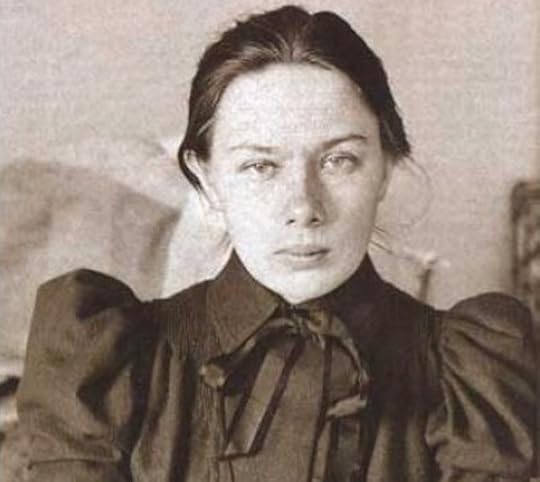
N.K.Krupskaya - At age twenty-eight she married Lenin

Fanya Kaplan - At age twenty-eight she shot Lenin
Anyway, Vollmann packs in historical facts and lyrical images as if he were stuffing twenty-five pounds of potatoes into a 10 pound sack, for example, we read the following of the last four days in Fanya Kaplan’s life after she shot Lenin: “a huddle of twenty-four grey subterranean hours like orphaned mice; and in the flesh of every hour a swarm of useless moments like ants whose queen has perished; and within each moment an uncountable multitude of instants resembling starpointed syllables shaken out of words."
If you were counting, that’s three tightly packed in similes. I read a Paris Review interview where Vollmann relates how at one time in his life he was writing sixteen hours a day. Now that’s a writer on fire! . . . and perhaps on cocaine, speed, or, at least, caffeine.
For the narrator of Europe Central, people stand tall like a certain letter of the alphabet, ideas glow like a letter, words hum like a letter, which reminds me of that Georges Perec quote: “Is the aleph that place in Borges from which the entire world is visible simultaneously, anything other than an alphabet?”
And these Europe Central times are times for men and women of action, as in the action-packed words of Comrade N. V. Krylenko “We must execute not only the guilty. Execution of the innocent will impress the masses even more.” Ironically, Comrade Krylenko would himself be shot – I wonder if the masses were impressed.
However, nobody could ever doubt Comrade Krylenko was a revolutionary who took his revolution seriously. And equally ironic, through all the revolutionary slaughter, one of N. K. Krepskaya’s very favorite books was Louisa May Alcott’s Little Women.
And there’s a scene of N. K. Krepskaya meeting Fanya Kaplan in a prison cell that provides a stroke of Latin American-style magical realism: "Then the letters disappeared into the woman's mouth. Krupskaya was speechless. The woman began to glow more and more, until the light from her was as white and pure as a page of the Torah."
One of my favorite parts of the novel is all the references to Dimitri Shostakovich and his music. For example: “Best listened to in a windowless room, better than best an airless room – correctly speaking a bunker sealed forever and enwrapped in tree-roots – the Eighth String Quartet of Shostakovich (Opus 110) is the living corpse of music, perfect in its horror. Call it the simultaneous asphyxiation and bleeding of melody.”
To gain a keener insight and feeling for this novel, I listened to this and other Shostakovich string quartets repeatedly during my reading. All in all, a great novel, but I must say not a novel exactly to my taste since I found, for one thing, the shifting first-person narrator (who, at points, could be the voice of the entire continent of Europe) at a huge emotional distance from the other characters. I contrast this with another 800 page novel set in Europe and Russia during WWII: The Kindly Ones by Jonathan Littell, a novel where the first-person narrator was a member of the Nazi SS. The evil of Littell's novel is so real, so immediate, so powerful, I had to listen to the audiobook while taking my walks and let the evil run down my legs and out the bottom of my feet. Europe Central is an encyclopedic literary monument to an incredible time in 20th century European history but, for me, Vollmann’s novel lacks the power of Littell’s.

William T. Vollmann
Comments
Post a Comment