The Night Will Be Long by Santiago Gamboa — spectacular storytelling, or, in Spanish, una narración espectacular. The contemporary Colombian author has written a nail-biting, propulsive, crime-driven thriller with an added element that contributes richness and depth: a scathing social commentary on the challenges Colombia and other Latin American countries face when religion turns international and is undergirded by massive amounts of money along with military-style weapons and firepower.
The opening pages set the tenor for the entire novel. A black Hummer with level-six armor, escorted by two Land Rovers, rumbles through a valley south of the Colombian city of Cali when it is suddenly hit by machine-gun fire coming from multiple nests. However, all three drivers possess good military training and maneuver their vehicles for the best possible defense. The attackers up the ante: they fire a bazooka, and the Hummer flies backward, crashes back to earth, and bursts into flames. The gunfire intensifies, but then the unexpected occurs: a helicopter arrives, uses radar to spot the attackers, and destroys them with its own machine guns. The helicopter then lands next to the Hummer, and a tall man dressed in black and two scantily clad young women clamber out of the vehicle and make their way to the helicopter. Once the trio are aboard, it lifts back into the air and disappears.
Violence and more violence. What’s with all the advanced weaponry? And how did a heavily armed helicopter mobilize so quickly? Since The Night Will Be Long is a thriller, and so as not to give too much away, I’ll shift to spotlighting a number of the tale’s major players and scorching specifics:
Julieta Lezama — a seasoned freelance journalist, age forty: urbane, worldly, divorced, mother of two teenage sons. Lusty and independent, Julieta likes drinking, has a strong sexual appetite, and isn’t afraid to throw herself into a dangerous investigation. Since she has a disdain for religion in general and is highly critical of the Pentecostal practice of demanding at least ten percent of earnings from even their poorest members, she serves in many ways as an anchor of common sense and the novel’s moral compass. And with Julieta’s surname we hear echoes of José Lezama Lima, Cuban author of the rococo novel Paradiso — most appropriate, as Julieta is herself multi-layered and richly sensuous.
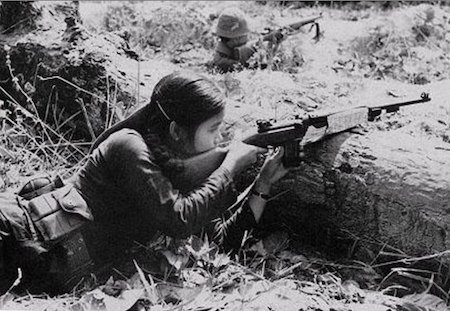
Johana Triviño — Julieta’s young assistant, a former Marxist guerrilla born and raised in rural Colombia. Although Johana shares her boss’s fearlessness and sense of independence, in some ways she is Julieta’s counterpart: rather than urban and sophisticated, Johana is tough, battle-tested, and earthy. Together, Julieta and Johana embody two Colombias and two generations —their partnership giving the novel both depth and range.
Office of the Prosecutor General — Headquartered in Bogotá, Edilson Jutsiñamuy heads the department, not an easy job considering the corruption throughout the government and police force at every level. However, Jutsiñamuy, in his fifties, is a man of integrity who has befriended both Julieta and Johana, as they have helped him uncover the truth in a number of cases over the past several years. And a key assistant working for Jutsiñamuy: Agent René Nicolás Laiseca, who, among his many other talents, is a computer whiz. Santiago Gamboa, you sly dog — the agent’s name, Laiseca, is surely a nod to the great Argentine novelist Alberto Laiseca, master of delirious realism, which suggests that everyday reality in Colombia can easily slide into surreal excesses of violence or into delirium triggered by such things as drugs, the thirst for power — and religious fanaticism.
The Kid — Julieta and Johana discover the sole eyewitness to that violent event in the valley: a fourteen-year-old named Franklin. Through Franklin, we meet his grandparents and learn about the Nasa people, Colombia’s largest indigenous group, who live primarily in the mountains. We’re also given a detailed account of Franklin’s father, Justino, who fought as a guerrilla on behalf of the Nasa people. Throughout the novel, Santiago Gamboa inserts a number of such personalized accounts of men and women and their past struggles — an effective way to infuse his thriller with the full weight of Colombia's social and cultural history along with illuminating the country's fractured present.
Pastor Fritz Almayer — Julieta attends a service conducted by Pastor Fritz at his New Jerusalem Church, supported mainly by the dispossessed and poverty-stricken. There’s little doubt that there is something powerfully appealing about this charismatic man, but is Pastor Fritz not only a man of God but also a manipulative opportunist — or, in rougher language, a slicker and a sleazeball? Why do many women warn that being around tall, handsome, magnetic Fritz is like playing with fire? One of Santiago Gamboa’s long-running themes involves institutions such as the church cloaking a craving for power and the use of violence under a veneer of piety and respectability.

Fabinho Henriquez — Claiming she’s conducting research for an article on gold mines, Julieta visits a mine in the Amazon jungle and meets Henriquez, a Brazilian industrial baron who is also the founder of evangelical churches affiliated with the Assemblies of God. Henriquez shares his dramatic background with Julieta, giving her a clear picture of how this business mogul has developed his international religion into something of an industry — financed by gold and protected by armed guards and a private army.
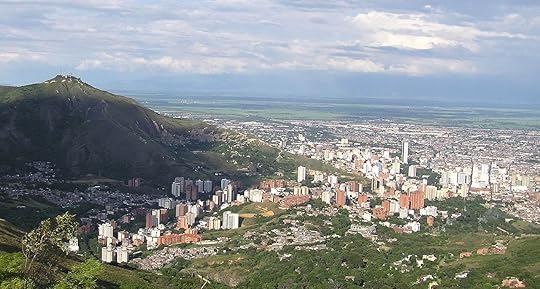
Multiple Murders – Further on in the tale, three corpses are found along a road. One disturbing clue: each corpse has a similar tattoo: an open hand with the words 'We are healed'. What's that all about? And then, even further along, in the beautiful Colombian city of Cali (photo above), four sicario murders at four different locations all within the same hour, one murder carried out at the small restaurant where Julieta and Johana were relaxing over coffee. As they say, the plot thickens.
Colombia — The author’s country has such a presence in the novel that it is almost a character in its own right. A telling instance: over breakfast, Johana and Julieta look out across the way at the abandoned mansion of Jorge Isaacs, the nineteenth-century Colombian author of María, a romantic novel filled with lovers, twinkling stars, and a loving moon. By contrast, Pastor Fritz recalls his own emotionally starved childhood, where others might see twinkling stars and a loving moon but, for him, the moon and stars are dead — a reminder of his own isolation and loneliness. It is as if Santiago Gamboa is reminding us that the promise of beauty and tenderness that the country’s literature once held is no longer available to a vast swath of the current population.
The Night Will Be Long, a gripping Latin American saga not to be missed.

Santiago Gamboa from Colombia, born 1965
Comments
Post a Comment