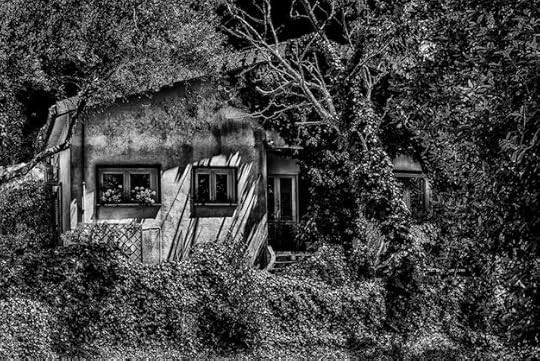
Years ago, for reasons connected to my wife’s family, I had occasion to make several visits to Renovo, a small town nestled in the mountains of central Pennsylvania. Renovo had once been a booming railroad hub before the Second World War, but after the war the railroad work began to dwindle, until in 1968 the Pennsylvania Railroad officially closed all the Renovo shops. Thereafter, Renovo became a dismal, depressing little town for anyone, like myself, who happened to walk its nearly deserted streets.
Each time I took my walks, I sensed something definitely off about the men, women, boys, and girls of Renovo. I wouldn’t say it was as if I were observing the inmates of a large psychiatric ward, but as I made my way up and down the sidewalks—passing the post office (the one remaining fresh-looking building on the main street) with its well-tended lawn, and a couple of bars (the only remaining thriving businesses)—there was a collective strangeness I found flat-out unsettling.
Michael Cisco takes this small-town strangeness to the outer reaches of the extreme in his story Intentionally Left Blank, where ghosts or other supernatural phenomena are not needed for it to qualify as a tale of horror.
It all starts one summer when the unnamed teenage narrator—a lad I’ll call Matt—tells us he’s staying with his Aunt Gabrielle, since his mother is in the hospital following a suicide attempt and his father has gone back to the base. Aunt Gabrielle lives in a white stucco house, one of a dozen houses built close together amid a tangle of intertwining cables, on a hilltop just up the road from a small town. Since there’s no one his age around, Matt feels “kind of stuck,” with not much to do.
Matt takes up residence in the guest room that juts out over the edge of the hill, where he can see into the backyard and garage of Dr. Wilson, a retired dentist and Civil War buff—an ordinary sort of older man. But then a bit of weirdness: Matt spots a shadow through a tarp—a guy helping Dr. Wilson with his car, a big guy with “some kind of wiggly things sticking out of their head.” Understandably perplexed, Matt wonders why such an odd happening was never mentioned by anyone living on the hill.
But then, a few days later, more weirdness: Matt gets a better look—a big man in the same sagging purple sweater is working in Dr. Wilson’s garden, wearing a rubber Halloween mask. When the man turns, Matt first takes it for a green gorilla mask, then a zombie, and then—seeing snake heads wiggling in the shaggy fake hair—he recognizes it as a Medusa mask, the eyes filled in with staring Medusa eyes “sort of sloppily painted there with paint like two splashes of bird shit.” How can this big guy see? Matt figures there must be slits under the eyes.
Matt tries to figure out what’s going on. As a product of our highly pragmatic and rationalist American society, he surmises the guy must have a gross face. But why doesn’t he wear some kind of medical mask for people with facial deformities instead of “some cheap, shitty drugstore mask”? However, the weirdness intensifies. Matt walks over to his Aunt Gabrielle and the woman she’s talking to—a Mrs. Figiel from across the street—and asks the ladies what’s the deal with the guy in the Medusa mask. The answer he receives is deeply disturbing: they say, without a trace of emotion or upset, yes, that guy usually has the mask on.
Michael Cisco provides many telling details to sustain a creepy, uncanny atmosphere and a mysterious tone as the tale unfolds. Matt’s anxiety and unease increase, especially as the days pass and he realizes there is more than one man wearing a Medusa mask working for Dr. Wilson. And why, Matt wonders, is the Halloween store in the small town still open in the middle of summer? He begins to question whether he is the strange one for caring so much, since nobody else seems to pay any mind. And the pressing issue: why doesn’t it bother them?
Then it happens: Matt finally musters the courage to ask the masked men a question. He receives a two-word answer. Those two words haunt him and drive him to leave his aunt’s house on the hill, go down into town, and enter the Halloween store. What follows is eerie—deeply eerie—leading the reader to reflect on a number of philosophic questions.
A prime question: What happens when what is accepted as “normal” is, in fact, profoundly disturbing? It might not be people wearing rubber Medusa masks, but what if you go to a small town and nearly all the townsfolk waddle around with misshapen, blob-like bodies? And what if those blobs spend most of their waking hours plopped in front of the idiot box—aka TV—pumping themselves full of booze and pills? Such is the plight of the vast majority of men and women in small towns across the country. Does this stinking, suffocating idiocy qualify as horror worthy of a horror story? I think the answer is obvious.
Comments
Post a Comment