
The Cage is part of Jeff VanderMeer’s City of Saints and Madmen, and it is a perfect example of what is termed New Weird fiction. Set in Ambergris, the strange city of the author’s unique creation, we’re treated to a tale that combines elements of science fiction, fantasy, and—most especially—horror. From my own reading, this is one eerie, frightening, unsettling, dark tale.
To share several hits of VanderMeer’s rasa, I will link my comments with several quotes taken from the first of five sections comprising this sixty-page story.
“The dark, narrow window reflected needlings of rain through its tubular green glass. It was the season of downpours in Ambergris. The rain would not let up for days on end, the skies blue-green-gray with moisture. Fruiting bodies would rise, fat and fecund, in all the hidden corners of the city. Nothing in the bruised sky would reveal whether it was morning, noon, or dusk.”
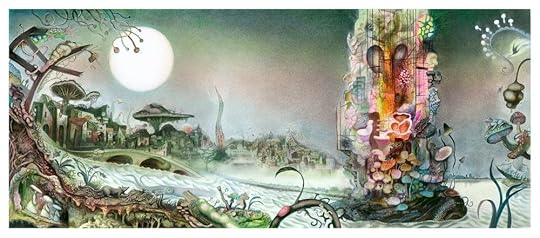
Thus we’re given the setting: rain and more rain in a city usually overflowing with mushrooms. However, as is established in the first few pages, these fungi—along with the mushroom dwellers (small gray beings, not entirely human, and thought by many to possess supernatural powers)—have become more aggressive toward the human inhabitants of Ambergris.
“The solicitor loosened his collar with one sharp tug. “It's been more than an hour. My clients are not well.” He was sweating profusely. A greenish pallor had begun to infiltrate his skin. Despite the sweat, the solicitor seemed parched. His mask puffed in and out from the violence of his speech.”
The ailing solicitor represents a family selling the contents of their mansion, victims of an attack by the mushroom dwellers. The mother, her hands recently hacked off, stands beside her wide-eyed, twitching son, while the mutilated bodies of her husband, another son, and her two daughters are being burned as a precaution—a scene reminiscent of the Plague or Black Death that ravaged Europe beginning in 1347. The solicitor is speaking to Robert Hoegbotton, one of the city’s leading merchants, who buys goods and sells them secondhand from his shop on the city’s main street.
“Hoegbotton would not have included the cage in his calculations if the boy's stare had not kept flickering wildly toward it and back down again, gliding like Hoegbotton's own over the remnants of the success that had become utter failure. For all the outlandish things in the room—the boy's own mother to be counted among them—the boy most feared the cage, an object that could no more hurt him than the green suitcase that hung from his arm.”
Hoegbotton walks away from the mansion (“the third time in the last nine months that he had been called to a house visited by the gray caps”) carrying the empty birdcage, now covered by a cloth sprinkled with luminous green dust. He plans to have his workers bring the other items to his store at a later date. Meanwhile, the boy has been transformed: his arms are dark green, fuzzy, and indistinct—and he is in total dread and fear of the cage. How wise, then, is Hoegbotton’s assumption that the cage can’t harm the boy? Doesn’t he remember the Great Silence, when thousands of humans disappeared in the city of Ambergris without a trace years before? When the laws of nature themselves may be violated, wouldn’t it be best to remain cautious?
"The city that flourished from wholesome activity by day became its opposite by night. Orgies had been reported in abandoned churches. Grotesque and lewd water puppet shows were staged down by the docks. Weekly, the merchant quarter held midnight auctions of paintings that could only be termed obscene. . . . In the Religious Quarter, the hard-pressed Truffidian priests tried to wrest back authority from the conflicting prophets Peterson and Stratton, whose dueling theologies infected ever-more violent followers.”
Once again, VanderMeer’s city might bring to mind a European commercial center during the Renaissance, yet his creation is entirely his own. The Truffidian priests have little in common with Christianity; there’s a Borges Bookstore; but above all, there are the mushroom dwellers—shrouded in mystery, creatures who, it seems, can transcend the laws of nature.
Back to Hoegbotton. He returns to his apartment with the cage only to find his wife, Rebecca, asleep. Light streams from her eyes—a silvery glow “awash with faint phosphorescent sparks of blue, green, and red.” The merchant wonders what the light means; he met Rebecca after the fungal infection that had resulted in her blindness.
The weirdness and eeriness build again and again. With The Cage, VanderMeer proves himself a master of horror equal to the likes of Poe and Ligotti—a tale once read, not forgotten.

American author Jeff VanderMeer, born 1968
Comments
Post a Comment