The Walk is a highly stimulating short story that prompts the reader to reflect on identity, agency, and the ethical decisions we are forced to make. SPOILER ALERT: since the central science-fiction premise of this Greg Egan tale does not fully reveal itself until the concluding scene, I will cover the entire story from beginning to end.
The story begins simply enough. Carter, a man in his fifties, leads the tale’s unnamed narrator—a twenty-five-year-old hacker I’ll call Drake—out into the woods with a pistol for a specific reason: Drake was caught stealing a huge amount of money. There is little doubt we are in the world of Greg Egan science fiction when Drake reflects on Carter: “However decent he might seem at first glance, the truth is, the man’s a fucking robot: he’s got some kind of neural implant, some bizarre religion; everybody knows that.”
Carter leads Drake deeper into the woods. Drake goes through the usual list: he tries to bargain with Carter, offering first money, then sex. It turns out Drake is number thirty-four; the older man has previously shot thirty-three victims. Drake asks him if the chip in his brain lets him sleep at night. Carter answers, “In a way. But it’s not as simple as that.”
Carter tells Drake not to bother trying to figure out a way to escape; it would be better to find a way to deal with his own death. Oh, great, Drake thinks—grief counseling from his executioner. More philosophic exchanges follow, until Carter says something unexpected: “I can help you. I can make this easier.” With his left hand, Carter reaches into his shirt pocket and takes out a small object—Drake recognizes it as a neural implant applicator. Carter tosses it to him.
The philosophic exchanges continue, until Carter articulates something provocative: “It’s seeing the life of your body as the life of one person that’s the illusion. The idea that ‘you’ are made up of all the events since your birth is nothing but a useful fiction. That’s not a person: it’s a composite, a mosaic.” What Carter describes shares much in common with the Buddhist idea of no-self—the notion that any sense we have of a solid, enduring self is a conceptual construct, a creation of the mind with no basis in reality.
Eventually, the exchanges reach a point where Drake reflects that since he is going to die anyway, it makes little difference how he faces death. He pushes the implant applicator deep into his right nostril and squeezes the trigger. There is a faint sting as the implant burrows into his nasal membranes, heading for his brain.
There is a soft thud, then a crash in the undergrowth, as Carter puts a bullet in Drake’s skull. Then, in Greg Egan’s words: “After a moment, I open my eyes and sink to my knees, shaking. For a while, I lose myself: sobbing, banging the ground with my fists, tearing up handfuls of weeds, screaming at the birds for silence.” Why the distress? Drake recognizes what transformation the neural implant has effected: he—Drake—now inhabits Carter’s body. He scrambles to his feet and walks over to the corpse. Drake reflects that Carter needed someone else who knew they were going to die, “someone else who was just as afraid as he was.”
The Walk poses a number of difficult questions. How solid is our individual identity? How would society and the law handle questions arising from the fact that Carter now exists as Drake’s consciousness inhabiting an older man’s body—the body that formerly belonged to Carter? Does Drake have the right to claim Carter’s wife and son? Does he assume responsibility for Carter’s previous murders? And why did Carter surrender his mind in the first place? What was in it for him? Perhaps one answer lies in the neural implant that stripped him of agency and rendered him a kind of zombie.
Greg Egan leaves these questions unanswered, a fact underscored by the tale’s closing lines: “I look down at Carter, nudge him with my foot, and whisper, ‘Who died today? Tell me. Who really died?’”

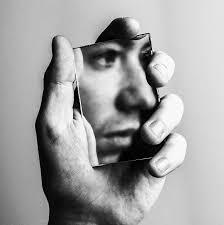
Australian author Greg Egan, born 1961 - Greg takes pride in not having any photos of himself available on the web. This photo is the way I picture the outstanding SF novelist writing at his computer.
Comments
Post a Comment