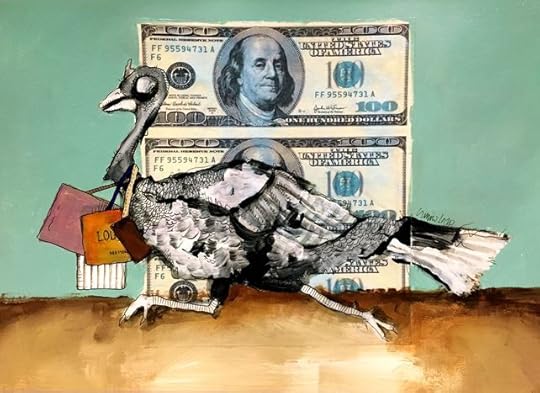
Slapstick, grotesque absurdism, and a hailstorm of the hallucinogenic hyperweird, anyone? Welcome to the world of Michael Cisco's Animal Money, a 780-pager published in 2015 by Lazy Fascist Press.
This Money of the Animal doorstop novel contains thirteen parts. To share a taste of Cisco's highly, highly experimental extravaganza, I'll zero in on select episodes from the first four.
PART ONE: ALBINO BLACKS
Ronald Crest, an assistant professor of economics at City University of New York, tells us he's currently attending an academic conference of economists in a South American city. However, he can't attend any of the meetings since he's recovering from a fractured skull and his head is heavily bandaged (he was whacked while walking one of the city's busy streets in broad daylight, the thief taking cash from his wallet along with his shoes and wristwatch). Turns out, he's not alone—four other economists suffered recent head injuries of one sort or another.
The injured economists are assigned a nurse. Cisco gives us this incisive, humorous line: “Whenever she flies into the room without a sound on thick carpet we all startle wildly disturbing our various injuries, and then, like a woodwind section tuning up, we groan with pain in our distinctive registers.” The nurse tells the group that she refuses to do any scurrying, which means, so Crest informs us, that she will not attend to each one individually in their own room but only as a group at a location of their choosing. The economists opt for the hotel library.
The novel's opening is so richly revealing on a number of levels. The economists relate a series of strange happenings among animals in nature lately. This leads them to formulate the idea of animal money—not exactly an exchange or currency—animal money is qualitative rather than quantitative, alive and evolving rather than dead and static.
Ah, economics as a qualitative science! As all five economists quickly grasp, they've hit on a revolutionary idea. And anybody familiar with the discipline of economics will quickly agree. All phases of economics—micro, macro, international, labor, developmental, political—are all driven by statistics, that is, quantities, numbers. Quality never enters the formula on any level.
Cycling back to the nurse attending the injured, it's all about dealing with quantity over quality—limiting her time by everyone gathering in one group. She has the power to set the rules and procedure and this she does—demanding operational convenience over individual care. In a way, Cisco, a Deleuzian, provides a vivid example of how modern society constricts individuals by things like performance measurement.
Animal money, quality over quantity, finds expression in many sidesplitting scenes in this section: the International Economics Institute requiring, among other absurd things, celibacy, a secret zoo within a zoo, a man enslaved by sexually deviant chimpanzees, luxury brand gravity, robot companions, communist aliens, and a woman's head flying in the air.
The concluding short paragraph to PART ONE adds postmodern, metafictional zest—we, as readers, are addressed: “One by one, we fade from view. You can't see us fade. You think we're all still there, until the ribbon of storytelling breaks and you realize, not only that you are alone, but that you have been alone.”
PART TWO: IN FOR QUESTIONING
A cool kat by the name of Superasop ganders at the idiotic questions asked as part of a job application and provides his chucklesome, waggish, wry answers. Anybody who has been subjected to a job interview (usually a degrading, humiliating experience, phony in the extreme) will appreciate the poopstickery.
Over 100 questions, like: Do you keep the Ten Commandments? Can you lift a hundred pounds and carry it twenty yards? Are you willing to remain permanently on premises? Do you think an employer should be feared or liked? Superasop shoots back: Have you ever recognized the suffering of a person other than yourself? Have you ever used your imagination? How do you live with yourself? And Superasop adds: My chief qualification is a boundless confidence in my need for money, which is a need anyone can depend on me to have reliably and at all times. . . . authorization for me to work here is provided by a grant from the rumbling stomach foundation." And, "I most enjoy working with people who are beautiful, freewheeling, inventive, forgiving, generous."
Of course, we'd all love to respond in a job interview and/or fill out a job application like Superasop . . . but, but, but such is not allowed by prospective employers who, as they say, "hold all the cards." In other words, in a capitalistic society, the vast majority of people are, as Marx knew, alienated from their jobs; they're working for a paycheck, in many cases, a nightmare with a paycheck.
PART THREE: NONSMOKING SMOKERS
Oh, my animal doubloons! We're treated to Monty Python absurdity sinking into Mikhail Bulgakov-style paranoia and violence. Can you believe economists must compete by going to a large public park and seeing how high they can jump? Ronald Crest broods, “I begin, it seems, to understand why the dark economists are always reading hermetic and occult literature. Secrecy is the medium of magical transactions (call them A) which compound value across exchanges instead of simply shifting equivalent values.” And make no mistake, friends, those economists who resist the set logic of our current capitalism become the targets of ridicule, surveillance, and a gaggle of creative tortures.
I came away from this part of the novel imagining my old economics prof back in college lighting incense candles, chanting, and invoking the gods as he outlined the shift in the demand curve.
PART FOUR: THE SHITUATION
In this section of the novel, Michael Cisco outdoes himself as a prime mover of the New Weird in fiction: there's a physicist who decides to resurrect her parents, proclaiming, in the spirit of Niels Bohr, that "a spell was the only way forward." The Money Animalizing world Cisco creates begins revving in high gear as magic is treated as interchangeable with science.
Animal Money is a challenging read, no doubt, but a novel that must be read to appreciate how far-out bat-ass weird Michael Cisco takes Weird Fiction.

American author Michael Cisco, born 1970
Comments
Post a Comment