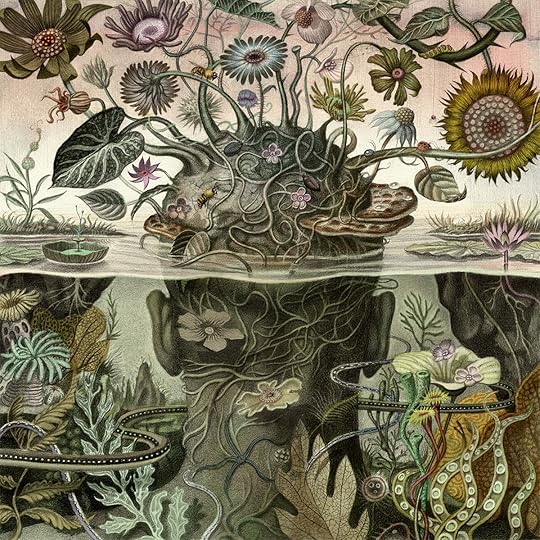
Dog-Eared Paperback of My Life. This novella written in 13 unnumbered chapters begins: "My name, Thomas Cradle, is not the most common of names, yet when I chanced upon a book written by another Thomas Cradle while looking up my own work on Amazon (a pastime to which I, like many authors, are frequently given), I thought little of it, and my overriding reaction was one of concern that this new and unknown Cradle might prove the superior of the known. I became even more concerned when I learned that the book, The Tea Forest, was a contemporary fantasy, this being the genre into which my own books were slotted."
Thomas Cradle digs deeper. He discovers The Tea Forest published in 2002, has a cult following and the author disappeared in Cambodia not long after the novel's publication. Cradle orders a used copy and gathers more information: the author (he refers to him as Cradle Two) was born in Carboro, North Carolina in 1968, attended the University of Virginia, traveled widely in Asia where he worked as a teacher of English and martial arts, and currently lives in Phenom Penh, The Tea Forest being his first novel.
Cradle feels the creeps. Not only did this guy share the same name, same place of birth, same school (U of Virginia), same martial arts training, but his photo looks eerily like himself! Was someone playing a practical joke on him? Cradle reads the first five chapters of Tea Forest and recognizes the book could not be the instrument of a prank.
The novel documents a trip down the Mekong River in a used fishing boat to the extreme south of Vietnam, an unfinished journey filled with misadventures and illness and crime—and concludes with a meditation on suicide. Cradle detects the novel is thinly disguised autobiography and the author's voice, thoughts, and perceptions are vaguely familiar. Furthermore, The Tea Forest was written in his own more literary style from his younger years only with greater literary flair. “It was as if he (Cradle Two) had become the writer I had chosen not to be.” And the novel concludes with a startling revelation: our universe is not singular: we are part of an interpenetrating multiverse! Cradle reflects that this must be the very reason he is unable to locate any more information about the novel or Cradle Two himself.
And there's more. In one part of the novel, deep in his journey downriver, the narrator (called TC) learns that one alternate universe has a secret figure of tremendous power, evil in nature, and that numerous other Thomas Cradles are men of debased character. At this point, Cradle decides to retrace Cradle Two's voyage along the Mekong and expects his journey will be, in some mysterious way, a fusing together of his own and Cradle Two's experience.
This Lucius Shepard novella is one of the most gripping, imaginative works of fiction I've encountered. There are many memorable episodes of Cradle's Asian adventure, including these four:
Opium Queen - Cradle arranges a houseboat to be built to accommodate his journey (his popular fiction has made him rich). Like Cradle Two, a trio will join him aboard—an experienced pilot, a cook, and a woman companion. He interviews a string of women and is nearly ready to give up when a slender, long-legged white gal with black hair cut in pageboy style walks in carrying a backpack. “She was more interesting-looking than pretty, yet pretty enough, with lively topaz eyes and one of those superprecise British accents that linger over each and every syllable, delicately tonguing the consonants, as if giving the language a blowjob.” Lucy McQuillen, thirty-one, a well-educated urban landscape designer, has read one of Cradle's novels and needs a break before returning to London. Perfect fit! But one of Lucy's conditions: she must be allowed to smoke two pipes of opium a day. As the pair make their way to Cradle's boat, he muses that he “anticipated losing a piece of my soul to this forthright, tomboyish, opium woman.”
Opium Dream – One night on the boat Lucy suggests Cradle smoke opium. Since Lucy has been sharing Cradle's bed, accepting her offer seems like the right thing to do. Shepard's language here is worthy of Théophile Gautier. A snatch of Cradle's intense high: “The lights in the sky appeared scattered at first but grew brighter and increasingly unified, proving to be the visible effulgence of a single creature. It was golden-white in color and many chambered, reminding me of those spectacular, luminous phantoms that range the Mindanao Trench, frail complexities surviving at depths that would crush a man in an instant; yet it was so vast, I could not have described its shape, only that it was huge and golden-white and many chambered. Its movements were slow and oceanic, a segment of the creature lifting as though upon a tide, and then an adjacent segment lifting as the first fell, creating a rippling effect that spread across its length and breath.” As Cradle eventually discovers, his opium visions have a profound connection to events in The Tea Forest—and beyond.
Phnom Penh Phantasmagoria – Interpenetrating multiple realities begin to overwhelm Cradle. He needs a break and stops with Lucy at an ancient Phenom Penh hotel where he spends five whole days confined to his room, attempting to deny and resist change. He finally ventures out to the city streets and one time with Lucy and another gal, a gorgeous blonde Canadian by the name of Riel who has joined them, the trio wander into a nightclub with the ominous name, Heart of Darkness. In a particular backroom the three adventurers must deal with boozy drama and an outburst of violence. Then it happens: Lucy tells Cradle that a Khmer girl said a mirror vanished off the wall. Cradle has his evidence—someone else has seen how our reality can instantly switch into another. And beautiful Riel? She's a heroin addict that Cradle has sex with at Lucy's insistence. “I liked how Riel, a sleepy heroin girl, would coast in sex, gliding, billowing, alone on her white ocean when I was joined to her.” Ah, women. If you want to add a dollop of ferocity to your river odyssey, get involved with not one but two lovely ladies.
Mr. Kurtz – Cradle leaves Lucy and Riel in Phnom Penh and takes the river south toward the Tea Forest solo and comes upon a shack with an enormous man. “He was well over three hundred pounds (closer to four, I reckoned), and stood a full head taller than I, clad in shorts and sandals and a collarless, sweat-stained shirt sewn of flour sacking, His arms and legs were speckled with inflamed insect bites, and his complexion was a sunburned pink, burst capillaries reddening his cheeks and nose; but for these variances, his bearded face, couched in an amused expression, was the porcine equivalent of my own.” And Cradle sees this giant not only has a Vietnamese woman chained as a slave but a roomful of notebooks and diaries in handwriting approximating his own.
Thomas Cradle moves further, much further, into a shattering of identity, memory, and narrative where, for him, any meaning in life becomes not singular but plural. Intrigued? I certainly hope so. Again, an extraordinary novella.
Comments
Post a Comment