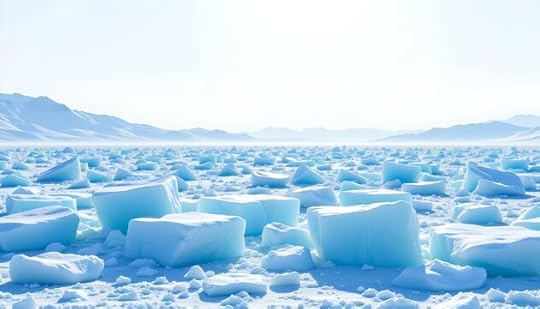
Ice by Polish author Jacek Dukaj combines alternative history with science fiction, depicting a world in which the 1908 Tunguska asteroid explosion in Siberia triggers an endless winter and the birth of alien ice beings—the “gleissen”—that defy the laws of chemistry and physics.
Originally published in Polish in 2007, this monumental work is now available in English thanks to the innovative publishing projects undertaken by Head of Zeus. Particular credit is due to Ursula Phillips for her fluid, highly readable translation.
From the opening pages, the world is mired in an ongoing crisis. The gleissen—silent, frozen harbingers of eternal subzero—spread across Russia and Europe, causing agriculture to collapse and rural populations to abandon the land and migrate to the cities. Equally dramatic, as the earth freezes, so too does history: the Russian Revolution never takes place; thus, Russia remains under the rule of the Tsar, and there is no First World War.
What is it like to live in a city invaded by the gleissen? The novel opens in Warsaw, where buildings are sheathed in ice and, in one part of the city, “the gleiss hung with its whole weight upon a star-shaped network of frost-strings, spreadeagled horizontally and stretching towards the façades of the corner buildings. It was possible to walk underneath, were anyone foolhardy enough to try.”
Predictably, children and teenagers develop their own response. One youngster “ran within a few feet of the gleiss and flung a cat at it. The mouser flew through the air in a high arc, spreading wide its paws, howling at the top of its lungs … a terrifying shriek broke loose. It was most likely dead already when it hit the gleiss, only to slide off slowly into the snow, frozen to the marrow: an ice sculpture of a cat with splayed limbs and tail straightened like a wire.”
What is to be done under such dire conditions? Since Poland remains under Russian rule, the Ministry of Winter dispatches Polish mathematician Benedykt Gierosławski aboard a Trans-Siberian train to locate his exiled father, Father Frost, who may, it is said, possess a unique ability to communicate with the gleissen.
Benedykt’s odyssey across Siberia brings him into contact with powerful political operators, secret societies, and figures over the length and breadth of frozen Europe, including the inventor Nikola Tesla. Along the way, he must also negotiate and wrestle with the novel’s central philosophical conflict: between determinism and cold logic (Ice) on the one hand, and freedom, chaos, and history (Thaw) on the other.
Ice is written in the tradition of the great nineteenth-century novels such as Tolstoy’s War and Peace and Dostoevsky’s The Brothers Karamazov: a work well over 1,000 pages that encompasses the full scope of society, culture, and history. One could easily write a twenty-page essay on Dukaj’s novel without exhausting its many facets. Since this is a book review rather than an extended essay, I will focus on one specific chapter that addresses critical elements of the novel largely overlooked in other reviews.
Roughly a third of the way into the novel, after many miles traveled aboard the train to Siberia, we encounter a pivotal chapter, On Winter—the moment when the gleissen in the external world and the freezing of the human mind—its conventional ideas of identity and worldview—begin to converge. A doctor examines his face in the mirror and wonders whether he can still shave. His mind is already being altered; the gleissen are reshaping his most basic assumptions about self and world. And his response? The good doctor recoils. Denial, rigidity, and self-preservation override any sense of awe or curiosity; his consciousness refuses to change in the face of a new reality.
Likewise, the other passengers retreat to the Bible, the story of Jonah, and the Christian idea of God—a longstanding human habit: when the world becomes strange, cling to the oldest stories you know. Benedykt, however, has already crossed into a new mode of thinking. He values powerful dreams, acknowledges shamanic symbolism and archetypal consciousness, and perceives the world as if contemplating a colossal mandala—a remarkable transformation, especially given that all this unfolds in the early twentieth century.
Looking out the windows, the passengers witness spark storms, rivers of fire, snow-white landscapes, and ice forming towers, vast ocean-like waves, ridges, and hives. These are not natural scenes; they are gleissen-forms—the geometry of a newly frozen metaphysical order. Ice may well be the first truly non-Western metaphysics to sweep through the Russian-European world.
Dukaj poses unsettling philosophical questions. In a world without World War I, without the trench slaughter, the collapse of empires in 1918, or the birth of fascism and Bolshevism, are the gleissen wholly malign? After all, they have prevented the worst human catastrophes of the twentieth century. Yes, the world is freezing—but does this represent stagnation, or the beginning of a strange and terrible salvation?
And Ice is never a single thing. It manifests as a metaphysical force, a political intervention, a spiritual phenomenon, a rewriting of history, and a source of new insight. Most dramatically, it reshapes the architecture of the human mind. Ice fractures consciousness and freezes logic—but it can also elevate thought and vision, awakening certain minds into a new, crystalline mode of being.
The bulk of the novel takes place in and around the Siberian ice city of Irkutsk. Many are the strange sights greeting a new arrival—one such: “On wooden masts ten arshins high, like on the poles of some ghostly flags, everywhere around, above the station, above the square, above the city—hung old corpses. Gutted carcasses of black-haired men, fastened by their twisted-back arms like wings, bedecked with pounds of ivory and iron amulets, ropes, fringes, chains, but moreover naked, naked, exposed to the very bone to public view. Ice had congealed them in statuesque poses; they do not hang, but look as if they stood on those poles like pagan incarnations of Saint Simeon Stylites.”
Dukaj’s imagination is unbounded in the myriad adventures and misadventures awaiting Benedykt on his odyssey in search of his father. Among the novel’s many dimensions is Ice’s profound influence not only on art, architecture, and aesthetic perception, but more fundamentally on the nature of logic and language itself. Ice fascinates, beguiles, and ultimately expands what it means to immerse oneself in a supremely creative work of fiction.
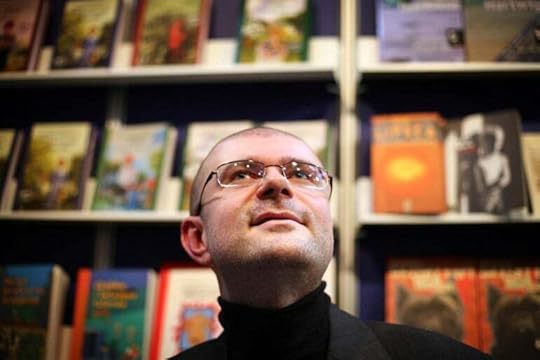
Polish science fiction author Jacek Dukaj, born 1974
Comments
Post a Comment