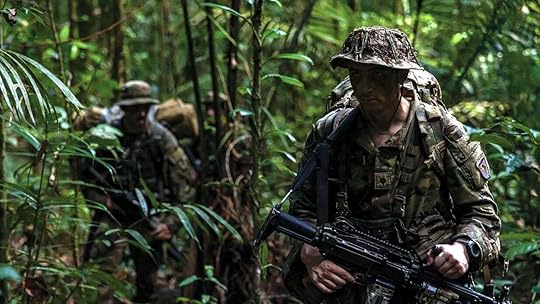
Salvador by Lucius Shepard is a tale of wartime brutality in the jungles of Central America. In twenty pages, Shepard portrays what it is like for a young American to live through the ghastliness of guerrilla warfare and then face civilian life— incredibly powerful and absolutely unforgettable.
Many are the excellent tales of jungle guerrilla warfare by such authors as Stephen Wright, Tim O'Brien, and Gustav Hasford. However, Salvador also qualifies as New Wave science fiction since Lucius Shepard adds a futuristic drug to the violent mix, a drug that turns soldiers into fearless killing machines moving at triple speed, the same unnamed drug readers will recognize from his novel Life During Wartime.
For an example of the drug's effects, here's young Dantzler, the tale's main character, in action with his platoon after popping ampules: “By the time he reached the base of the cone, he was all rage and reflexes. He spent the next forty minutes spinning acrobatically through the thickets, spraying shadows with bursts of his M-18; yet part of his mind remained distant from the action, marveling at his efficiency, at the comic-strip enthusiasm he felt for the task of killing. He shouted at the men he shot, and he shot them many more times than was necessary, like a child playing soldier."
DT—big, Black, with heavily muscled arms, crudely shaped features, and hands covered by jail tattoos—serves as the man in charge of Dantzler's platoon. DT did a stretch behind bars for attempted murder and some of his men say he's crazy since DT thinks the ampules open a man up to his inner nature, where you “just actin' natural.”
Following the battle, on the way down the mountain slope, the platoon discovers an Indian kid about nineteen or twenty. “Black hair, adobe skin, and heavy-lidded brown eyes, Dantzler, whose father was an anthropologist and had done fieldwork in Salvador, figured him for a Santa Ana tribesman.” The men take the kid aboard the chopper with them, DT having the kid sit by the open door.
Dantzler asks the kid if there are any more soldiers in the area but receives no reply. Then the kid senses something in Dantzler, a kindred soul of sorts, and tells him that his village is Santander Jiménez and his father is a man of power. Meanwhile, DT starts singing a song, the theme from Star Trek, and, getting in the spirit of things, the men join in, as does the kid, who even smiles at everyone and sways back and forth. Abruptly, the music stops. All the men stare at the kid, “their expressions slack and dispirited.” Then it happens: “Space!” shouts DT, giving the kid a little shove. “The final frontier.” The kid is still smiling when he topples out, the jungle far below. Dantzler feels like screaming but remains silent.
The tale clicks into a different, eerier register when the platoon receives word that their next mission will take them through Morazán Province. Their panic is whole justified. “Morazán Province was spook country. Santa Ana spooks. Flights of birds have been reported to attack patrols; animals appeared at the perimeters of campsites and vanished when you shot at them; dreams afflicted everyone who ventured there.”
And Dantzler has a more specific reason to panic since he's been having a recurrent dream. “In it the kid DT had killed was pinwheeling down through a golden fog, his T-shirt visible against the rolling backdrop, and sometimes a voice would boom out of the fog, saying 'You are killing my son'.
As for what happens to Dantzler and the other men when they're on a jungle mountain in this mysterious cloud forest, you'll have to read for yourself. And, for Dantzler, this episode will prove the most nightmarish in his young life, both while it is happening and when he's back in the U.S., first in a VA hospital, then at home. Recall I wrote 'the ghastliness of guerrilla warfare' at the outset. As Lucius Shepard makes painfully, excruciatingly clear, this description is a gross understatement.
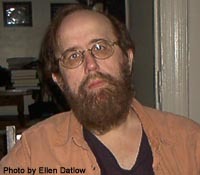
American author Lucius Shepard, 1943-2014
Comments
Post a Comment