The Last Time by Lucius Shepard
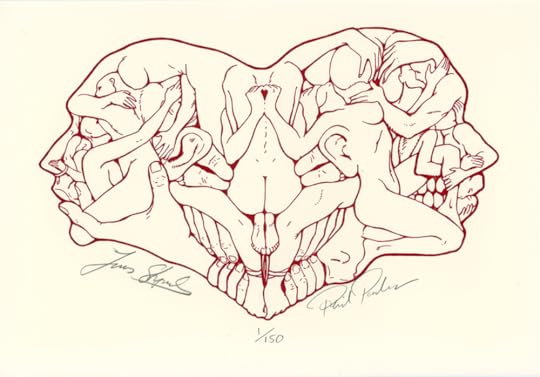
A note from the publisher of the limited-edition of this Lucius Shepard novella reads: "We tried something different for this book, the book is bound in dark red material with cream stamping, and the pages are printed in dark red on cream stock. Tom Joyce wrote an excellent essay on collecting Lucius Shepard’s books. The lithograph is signed by Lucius Shepard and Phil Parks and was included with all editions. Lucius Shepard hand wrote the beginning of a short story for the collector’s edition. Each of these stories is different." And the limited-edition showcases the above art that captures the pulse of this intense work of fiction.
Additionally, The Last Time is one of fourteen stories collected in The Best of Lucius Shepard, Volume Two available online at a very affordable price. The novella is a mere forty pages and written in six unforgettable chapters.
Chapter 1 begins: "These new drugs separate me from madness by the thinnest of chemical partitions. Normally I sit in my room with the weather of madness—I picture it as a ceiling of turbulent lightning-filled clouds—seething about me, lowered to cover my skull, my eyes, occluding all my senses; but now it is as if that ceiling has lifted to inches above my head, and though I can hear the thunder and smell the ozone, I am sufficiently lucid to participate in life, rather than, as has been the case for almost three years, to sit and stare at the minimal operations of my existence, baths and feeding and such, take place around me." For the past nearly three years, the narrator has been locked up in a maximum-security prison for the criminally insane.
Chapter 2 switches to his written chronicle of his relationship with Kathleen Cardoza: "how it began and how it thrived, and the terrible, sad thing that came of it." As we eventually discover, his tale is one of obsessive love that veers into extreme, visceral body horror.
The narrator, a thirty-three-year-old with the surname Autrey, recounts how he met Kathleen in the summer of 1988 at a cocktail party hosted by his New York Times editor to celebrate his release from a Guatemalan prison and the publication of his running account of the political terror in that country. In turn, Kathleen, a striking redhead with a “curious imbalance of Irish and Italian features,” has been recently hired by ABC News to work as an anchor for its evening broadcast. Autrey and Kathleen talk at length, and one thing becomes clear: Kathleen is unhappily married—very unhappily married.
For the next ten months, Autrey is obliged to take a leave of absence from the Times to live in his uncle's Virginia farmhouse. His uncle, who has terminal cancer, raised Autrey following the death of his parents. Autrey hesitates to call Kathleen since he was involved with another married woman several years prior that proved to be a brutalizing, ugly experience. After some time, Autrey takes up with a good-looking divorcee he meets at the local roadhouse, but this affair also ends in disaster: the thirtyish Southern honey turns religious and tells Autrey her lustful, passionate self is against God's law and just plain wrong. Feeling completely isolated as his uncle's primary caretaker, Autrey initiates a long-distance relationship via telephone with Kathleen—his loneliness and her unhappiness cement their bond.
After more telephone calls, Autrey tells Kathleen he loves her and Kathleen tells Autrey she loves him. Autrey returns to New York and Kathleen moves out of her husband's apartment. For close to a year, although they maintain their own apartments, the two lovers are essentially living together.
What is the quality of their relationship and what brings it to an end? As a way of providing answers, I'll link my comments to what I judge to be key observations in what Autrey has written down in his chronicle.
Once Autrey moved to New York, Kathleen began penning lengthy letters. “But what struck me as curious about Kathleen's letter, about all of her letters, is that there was never a single mention of tenderness, of sweetness, of any of the qualities that served as the setting for our passion, qualities that women generally prize about the basics of sex. . . Kathleen absorbed the flamboyant aspects of sex, by the number of times we made it and the duration of each encounter, and by the exotic deployment of our bodies.”
Autrey isn't a college sophomore; he's thirty-three with a seasoned background in journalism during the tumultuous 1980s in Guatemala, a time of bloody civil war and systematic genocide of the Mayan people—men, women, children. Not to mention he spent a stretch in a Guatemalan prison. He certainly should have known Kathleen's focus on the kinky details of sex to the exclusion of her feelings provided abundant reason to set off alarm bells.
“I did not, for instance, incorporate into my analysis the fact that Kathleen was a liar of almost pathological proportions; I was unaware of it then, and so was unaware that much of the information she relayed to me was useless.”
We're all familiar with the saying “love is blind,” but Autrey exhibits a colossal blind spot. Given his extensive background—especially his history of failed relationships—he should have picked up on the fact that Kathleen is a pathological liar; that is, someone incapable of telling the truth. Without a foundation of trust and honesty, any claims of love ring superficial and hollow. But one could argue that Autrey's passion, fueled by large quantities of cocaine, was so fierce that his capacity for critical analysis was rendered nonexistent.
“Or perhaps I had an intimation of the future, perhaps I knew in my secret heart the strength of my obsession, the lengths to which I was prepared to go in order to achieve my ends.”
Michael Autrey (we learn his first name deep into the story) is spot-on to cite the lengths to which he was prepared to go to have Kathleen all to himself. As he informs us at the very beginning, he has always felt free to exercise his superstitious nature: “to buy charms, to consult psychics, and so forth.” It is that “and so forth” that proves the killer.
After reading The Last Time, I can see there is good reason A.S.A.P. Publishing produced their limited edition of this Lucius Shepard novella using red ink.
American author Lucius Shepard, 1943-2014
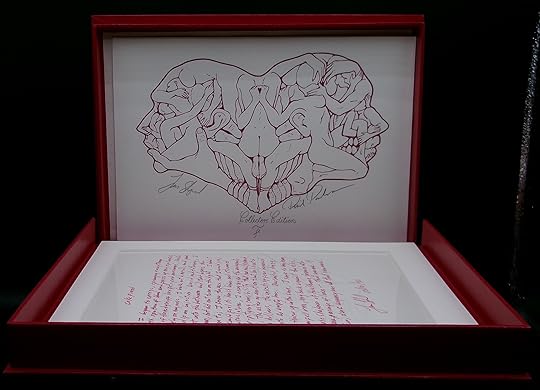
A note from the publisher of the limited-edition of this Lucius Shepard novella reads: "We tried something different for this book, the book is bound in dark red material with cream stamping, and the pages are printed in dark red on cream stock. Tom Joyce wrote an excellent essay on collecting Lucius Shepard’s books. The lithograph is signed by Lucius Shepard and Phil Parks and was included with all editions. Lucius Shepard hand wrote the beginning of a short story for the collector’s edition. Each of these stories is different." And the limited-edition showcases the above art that captures the pulse of this intense work of fiction.
Additionally, The Last Time is one of fourteen stories collected in The Best of Lucius Shepard, Volume Two available online at a very affordable price. The novella is a mere forty pages and written in six unforgettable chapters.
Chapter 1 begins: "These new drugs separate me from madness by the thinnest of chemical partitions. Normally I sit in my room with the weather of madness—I picture it as a ceiling of turbulent lightning-filled clouds—seething about me, lowered to cover my skull, my eyes, occluding all my senses; but now it is as if that ceiling has lifted to inches above my head, and though I can hear the thunder and smell the ozone, I am sufficiently lucid to participate in life, rather than, as has been the case for almost three years, to sit and stare at the minimal operations of my existence, baths and feeding and such, take place around me." For the past nearly three years, the narrator has been locked up in a maximum-security prison for the criminally insane.
Chapter 2 switches to his written chronicle of his relationship with Kathleen Cardoza: "how it began and how it thrived, and the terrible, sad thing that came of it." As we eventually discover, his tale is one of obsessive love that veers into extreme, visceral body horror.
The narrator, a thirty-three-year-old with the surname Autrey, recounts how he met Kathleen in the summer of 1988 at a cocktail party hosted by his New York Times editor to celebrate his release from a Guatemalan prison and the publication of his running account of the political terror in that country. In turn, Kathleen, a striking redhead with a “curious imbalance of Irish and Italian features,” has been recently hired by ABC News to work as an anchor for its evening broadcast. Autrey and Kathleen talk at length, and one thing becomes clear: Kathleen is unhappily married—very unhappily married.
For the next ten months, Autrey is obliged to take a leave of absence from the Times to live in his uncle's Virginia farmhouse. His uncle, who has terminal cancer, raised Autrey following the death of his parents. Autrey hesitates to call Kathleen since he was involved with another married woman several years prior that proved to be a brutalizing, ugly experience. After some time, Autrey takes up with a good-looking divorcee he meets at the local roadhouse, but this affair also ends in disaster: the thirtyish Southern honey turns religious and tells Autrey her lustful, passionate self is against God's law and just plain wrong. Feeling completely isolated as his uncle's primary caretaker, Autrey initiates a long-distance relationship via telephone with Kathleen—his loneliness and her unhappiness cement their bond.
After more telephone calls, Autrey tells Kathleen he loves her and Kathleen tells Autrey she loves him. Autrey returns to New York and Kathleen moves out of her husband's apartment. For close to a year, although they maintain their own apartments, the two lovers are essentially living together.
What is the quality of their relationship and what brings it to an end? As a way of providing answers, I'll link my comments to what I judge to be key observations in what Autrey has written down in his chronicle.
Once Autrey moved to New York, Kathleen began penning lengthy letters. “But what struck me as curious about Kathleen's letter, about all of her letters, is that there was never a single mention of tenderness, of sweetness, of any of the qualities that served as the setting for our passion, qualities that women generally prize about the basics of sex. . . Kathleen absorbed the flamboyant aspects of sex, by the number of times we made it and the duration of each encounter, and by the exotic deployment of our bodies.”
Autrey isn't a college sophomore; he's thirty-three with a seasoned background in journalism during the tumultuous 1980s in Guatemala, a time of bloody civil war and systematic genocide of the Mayan people—men, women, children. Not to mention he spent a stretch in a Guatemalan prison. He certainly should have known Kathleen's focus on the kinky details of sex to the exclusion of her feelings provided abundant reason to set off alarm bells.
“I did not, for instance, incorporate into my analysis the fact that Kathleen was a liar of almost pathological proportions; I was unaware of it then, and so was unaware that much of the information she relayed to me was useless.”
We're all familiar with the saying “love is blind,” but Autrey exhibits a colossal blind spot. Given his extensive background—especially his history of failed relationships—he should have picked up on the fact that Kathleen is a pathological liar; that is, someone incapable of telling the truth. Without a foundation of trust and honesty, any claims of love ring superficial and hollow. But one could argue that Autrey's passion, fueled by large quantities of cocaine, was so fierce that his capacity for critical analysis was rendered nonexistent.
“Or perhaps I had an intimation of the future, perhaps I knew in my secret heart the strength of my obsession, the lengths to which I was prepared to go in order to achieve my ends.”
Michael Autrey (we learn his first name deep into the story) is spot-on to cite the lengths to which he was prepared to go to have Kathleen all to himself. As he informs us at the very beginning, he has always felt free to exercise his superstitious nature: “to buy charms, to consult psychics, and so forth.” It is that “and so forth” that proves the killer.
After reading The Last Time, I can see there is good reason A.S.A.P. Publishing produced their limited edition of this Lucius Shepard novella using red ink.
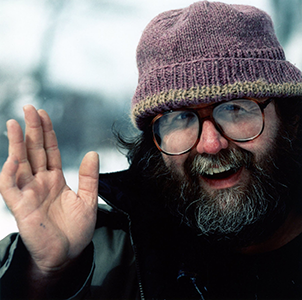
American author Lucius Shepard, 1943-2014
Comments
Post a Comment