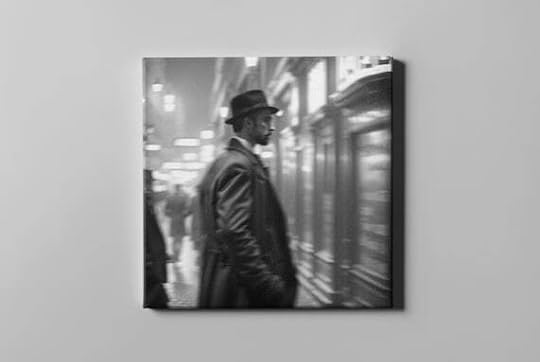
The Sealed Door by Julio Cortázar is a short tale that has fascinated and beguiled readers and critics since its initial publication in 1956.
“Petrone liked the Cervantes Hotel for reasons that would have displeased others. It was a gloomy, quiet, almost deserted hotel.” The hotel was in downtown Montevideo, near where he would be attending business meetings over the next week. “Petrone accepted a room with a bathroom on the second floor, which opened directly onto the reception room.” The manager told Petrone that the second floor was very quiet and that the only other person staying there was a solitary woman in the room next to his.
The next day, following a day of conversations in his colleagues’ office and dinner at the home of the senior manager, Petrone returned to the hotel shortly after one in the morning. Tired, he fell asleep immediately and remained sound asleep until almost nine. When he woke, “in those first minutes as the remains of the night and of sleep persisted, he thought that at some point he had been bothered by the cry of an infant.”
The cry of an infant? The manager had told Petrone that there was only a solitary woman on the second floor. Might Petrone have dreamed of a child crying? Or perhaps there was some other sound, like water in the pipes. Cortázar has provided readers with the first hint of the fantastic—the intrusion of the inexplicable into daily life—one of the author’s abiding themes.
Before leaving for work, Petrone had a chat with the employee working at the reception desk. “Whenever the employee and Petrone fell quiet, the hotel’s silence seemed to coagulate and fall like ashes over the furniture and floor tiles.” When Petrone returned to the hotel that evening, before going to bed, he sensed that the silence “was almost excessive.” Cortázar displays extraordinary perceptiveness here. Petrone, who has become exceptionally attuned to silence, will also continue to be a victim of hypersensitivity to sound. As we all have experienced—especially when lying in bed trying to fall asleep—any sound, even the gentle hum of an electric fan, can strike us as loud and irritating.
Petrone looked at himself in the wardrobe mirror and noticed for the first time a door that led into the adjoining room. “The door was there, in any case, protruding above the height of the wardrobe. Once upon a time, people had entered and exited through it.” He imagined a wardrobe on the other side of the door, and the solitary woman having the same thoughts about it. In this way, the door can be taken as both a barrier and a gateway. Might we liken this door to written words, with the writer on one side and the reader on the other? Considering this is a Cortázar tale, such a question is entirely reasonable.
Petrone wasn’t tired, but he slept with relish. After three or four hours, he was awakened by “a sensation of discomfort, as if something had occurred, something annoying and irritating.” He turned on the bedside lamp: two-thirty. Then, from the adjoining room, Petrone heard a child’s cry. He realized it was the same sound he had heard the previous night, which made it easier to go back to sleep. But then he thought about it again—the same crying with faint moans, hiccups, and sobbing, as if the child (he imagined a baby boy) were very ill. Damn. If the door had not been there, the walls were thick enough that he would not have known there was a child crying in the other room.
Petrone woke a second time: over and above the crying, he could hear the anxious voice of the woman attempting to calm the child, then whimpers and a lullaby, followed by more whimpering and “a mother’s incantation to hush a baby tormented by his body or his soul, for being alive or for being threatened by death.” In the morning comes a confrontation with the manager, who insists there is only a solitary woman in the next room.
That night, the drama continues. “He was not fully awake even though it would have been impossible for him to fall asleep; without knowing how, he found himself moving the closet little by little until the dusty and dirty door was exposed. In pajamas and barefoot, he clung to it like a centipede, and bringing his mouth close to the pine boards, he began to imitate in falsetto, imperceptibly, a moan like the one coming from the other side. He got louder, moaned, sobbed. On the other side there was a silence that was to last all night; but the instant before it began, Petrone could hear the woman running across the room with a slap of her slippers, uttering a dry, instantaneous scream, a beginning of a shriek suddenly cut short like a taut rope.”
And—vintage Cortázar—there is still more drama leading up to the shocking concluding sentence.
Shifting to the philosophical, a number of questions present themselves. Since all aspects of this tale are veiled in uncertainty, is the mystery primarily psychological, auditory, or—judging from what happens at the end—paranormal? Many readers, with some justification, have chosen to label The Sealed Door a horror story.
The story can also be read through another philosophic lens. For French philosopher Jean-Luc Nancy, existence is never solitary but always co-existence: we are, from the outset, exposed to others. In The Sealed Door, the fantastic sharpens this insight into terror. Petrone is not confronted with an intruder from another world, but with the unbearable fact that there is no true separation—no soundproof wall, no sealed self. The door does not protect him from reality; it exposes him to it, revealing existence itself as shared, open, and profoundly unsettling.
Comments
Post a Comment