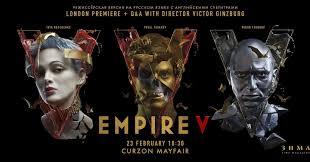
Empire V is Victor Pelevin's 2006 novel where the narrator, a twenty-year-old man living in Moscow, is turned into a vampire. Roman Aleksandrovich Shtorkin is given the name of Roma and we follow each step of his initiation into a full-fledged member of the vampire elite.
To highlight several intriguing philosophical issues, I'll take a somewhat unorthodox approach for this review by answering a number of questions posed by a friend of mine (we did a buddy-read) who wanted my reflections recognizing my background in ancient philosophy and Buddhist meditation.
How do the vampires go about turning this young Russian into a vampire?
The key transformation is made by forcing Roman to act as a host to incorporate “The Tongue” as part of his mouth region, a process that takes place while he is unconscious. This organic entity acts as a parasite that connects Roman to the bat consciousness of the vampire empire's “Mighty Bat” and alters Roman's perception.
This diabolical procedure complete, Roman, now called Roma, will undergo indoctrination and training from different teachers in what the vampires term “glamour” and “discourse” — the ultimate goal being the control of human society so the vampires can feed on the human life-force which has a direct connection to money.
Could you expand on this process?
Sure. Let's start with glamour. The vampire empire uses glamour to flood the human senses by things like fashion magazines, luxury consumer goods, advertising, and loud music. The senses being continually agitated will keep humans craving for more and more, superficiality without end.
Discourse acts more on the level of language, keeping human minds agitated in their own swirl of words, words, words. And all the words will be directed to form concepts and values with financial wealth and consumerism as the ultimate value.
Working in combination, glamour and discourse make sure humans are completely unaware of their own enslavement, oblivious to their being trapped by superficial desires under the control of the vampire empire.
And the vampires are superior?
Yes and no. The vampires certainly have more power, more knowledge of the mechanism that keeps human society humming. Vampires consume what they call “bablos” which is a concentrated essence of human vitality which enhances their power. They even possess an ability to eat “death candy” which will make them super-warriors. The head vampires continually tell Rama that he is no longer human and should cease thinking like a human. But, and here's the rub: vampires crave power, control, and status. They desire better cloths; they experience boredom and frustration. So, in this sense, they are very much like humans — caught in the realm of desire.
In one vast vampire hallway, there are busts of great ancient philosophers: Socrates and Marcus Aurelius. However, what the vampires lack is the wisdom of these profound thinkers. Personally, as a student of ancient philosophy and someone who has practiced Buddhist meditation for many years, I am not at all impressed with the vampires and their vampire empire.
Victor Pelevin is a Buddhist. What do you sense he's telling us about ourselves in Empire V?
I think many readers and reviewers will see Pelevin's novel as strongly anti-capitalism. In a way, this is valid, but I sense there are deeper issues he's addressing. Beyond any political or economic ideology, there's omnipresent modern mass culture which cultivates passivity, uses repetition to dull perception, and promotes spectacle as a way of replacing reflection. So much so that silence, solitude, and stillness are devalued and frequently even seen as dreaded enemies.
Taken even further, Pelevin seems to be saying mass culture doesn’t suppress barbarism — it packages it. Violence becomes aesthetic experience. Aggression becomes narrative catharsis. Domination becomes glamour. Now men, women, and children are truly at risk. If anybody doubts this, take a moment to think of all the TV shows and films where gun and violence are central to the story, and, in many cases, taken as the solution to society's problems.
Does Victor Pelevin point to any way out?
Rama is transformed into a vampire, but, unlike his fellow vampires, he retains an element of humanity. To see how this plays out in the novel's unfolding, I would encourage a careful reading of Empire V.
Comments
Post a Comment