Scottish author Andrew Crumey’s elegant Pfitz can be read in a day. However, if you’re one of those readers who takes great joy in literary brainteasers created by such well-known figures as Italo Calvino, Georges Perec, and Jorge Luis Borges, then you’ll want to take your time with each of the novel’s twenty-two chapters, rereading and reflecting on select passages, events, and happenings to make sure you’re keeping an accurate account of what’s going on—and how what you’ve just read fits into the overarching thrust of the story, and the story within the story within the story.
The novel is framed thus: an eighteenth-century Prince seeks immortality by dedicating himself to designing fantastic cities constructed not of brick and mortar, but solely of ideas and blueprints. His first city, Margaretenburg, is created to memorialize a lost love. Three more cities follow: one devoted to pleasure, another to celebration, and a third to entertainment. But, alas, the Prince understands that these three cities contain no real lasting worth.
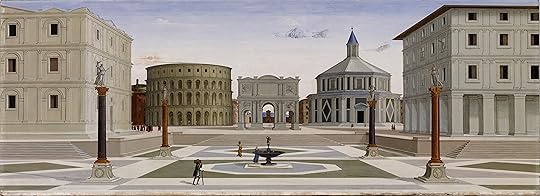
The Prince reflects: What type of city would be worthy of his vision and count as his crowning achievement? He recognizes that such a city, by its very nature, would be incapable of completion and closure—but he would gladly continue work on it for the remainder of his life. After much study and reflection, the Prince has his answer: the City as Encyclopedia, with a museum and library at its center—a city planned down to the finest detail, where absolutely nothing would be left incomplete—a city the Prince blesses with the name Rreinnstadt.
Rreinnstadt, a city built by the collective imagination of the Prince’s subjects, would include not only all the architectural and mechanical details of buildings and avenues; it would also incorporate the biographies, memories, and reminiscences of the city’s citizens. A painstaking project taking many years, yet each and every subject would receive the ultimate reward of having their name carved below the Prince’s on a great monument located in the central square opposite the museum and library. At the foot of the monument, the inscription would read: “To the memory of those who gave everything, that Rreinnstadt may live forever.”
All appears to be going according to the Prince’s plan—until we learn of an unusual occurrence. Schenck, a cartographer who has been working on Rreinnstadt since the project’s inception, discovers a name—Pfitz—that has been partially erased on one of his maps. This Pfitz appears to be the servant of a certain Count, the very same Count whose biography a beautiful lady named Estrella, in the Biographical Division, is preparing. To impress Estrella, Schenck invents Pfitz’s life and stories.
In this way, Andrew Crumey sets the stage for several philosophical queries and conundrums. Since he cannot unearth any facts or references to Pfitz in the official documents, Schenck reflects: “What was there to prevent him from inventing Pfitz’s story himself?” And herein lies the rub: Schenck is a cartographer; he is not part of the Literature Division. However, in his assigned role, he must ensure that nothing remains incomplete. Pfitz without a story would constitute a gross instance of incompleteness. Therefore, to remedy this obvious omission, Schenck sets pen to paper to bring Pfitz to life.
Turning to the philosophical, we can ask whether models, maps, stories, and biographies can assume greater significance than everyday reality. Are we entering a realm in which biography precedes existence? And what happens when those thus created—as eventually occurs in Crumey’s tale—begin to wonder whether they are merely characters in somebody else’s mind?
An attendant in the Literature Department informs Schenck that he is one of many members on a committee charged with writing a novel by an author named Rimmler. Schenck asks, “How can an original work of fiction—and even a personality—be produced by such a large group of people?” The attendant replies, “Are you sure that isn’t how it all really happens? When I sit down to write Rimmler, how many voices do I hear within my own mind? Can you be certain that you yourself are truly a single person and not many within one body?”
The attendant’s answer mirrors David Hume’s Bundle Theory of the Self, in which the mind is a stage upon which various identities strut and fret their drama for a time before exiting. His response also echoes the Buddhist notion that any solid, unchanging self is but an illusion. Additionally, the attendant advances the idea that individuals and their thinking are part of a vast web of social, cultural, and historical influences. In this light, a novel written by a committee may actually be truer to life.
Deep into the novel, we read: “The writer who invents a story invents also the teller of that story. And the one who tells a story invents his listener.” Further along, we encounter the idea that an author creates a character—and that the character, in turn, loops back to create (or at least influence) the author. Philosophically, this dynamic suggests that Andrew Crumey is not identical to the narrator of Pfitz. Why? According to this view, to write is to adopt a persona—that is, to become a teller with a specific voice, tone, and perspective.
As for a character looping back to affect the author, consider a familiar example: Hermann Hesse created Harry Haller, the Steppenwolf. As Hesse himself documents, Haller seemed to take on a life of his own, with such force that it was as if Haller dominated the story’s events leading up to—and including—the Magic Theater. Hesse also acknowledged that writing Steppenwolf helped him better understand his own life, particularly through the Jungian analysis he was undergoing at the time.
Pfitz presents a world in which creators—ranging from biographers to novelists to cartographers and even Princes—may not be sovereign within their own creations: a world in which Pfitz can influence Schenck, who can, in turn, influence the construction of Rreinnstadt, which, in turn, can influence Andrew Crumey, who can influence the way a reader—this reader, certainly—comes to appreciate the various levels within a narrative and the interconnectedness of fiction and life, life and imagination, and imagination and the power of great literature. I recognize that I have created my own bit of looping, but in this case, it is entirely justified.
As the eminent literary critic James Wood has observed: “Andrew Crumey’s work has been highly praised and not widely enough read for too long.” I agree entirely. If my review nudges others in Andrew Crumey’s direction, I will have done my job as a reviewer.
=================
*Note: I've read and reviewed over 1,500 books. This novel by Andrew Crumey was perhaps the most challenging to compose a review - so many levels within his story, so many philosophical ideas at play. Fortunately, the language was straightforward and light, reminding me of Serbian author Zoran Živković.
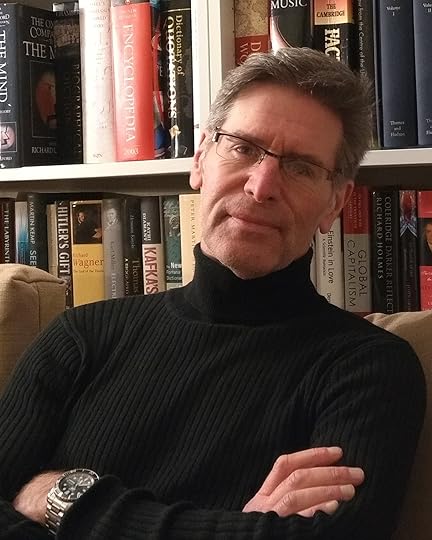
Scottish novelist Andrew Crumey, born 1961
*Note: I've read and reviewed over 1,500 books. This novel by Andrew Crumey was perhaps the most challenging to compose a review - so many levels within his story, so many philosophical ideas at play. Fortunately, the language was straightforward and light, reminding me of Serbian author Zoran Živković.
Scottish novelist Andrew Crumey, born 1961
Comments
Post a Comment