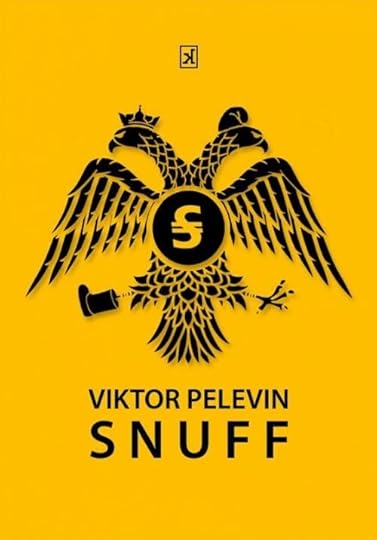
S.N.U.F.F. by Victor Pelevin is an extraordinary novel that takes place in a distant future where the world is divided between the vast, technologically advanced sky-city of Byzantium (Big Byz) and the impoverished, "barbaric" land of the Orks (Urkaine).
Within the novel, S.N.U.F.F. is an acronym that stands for "Special Newsreel/Universal Feature Film," reflecting the story's focus on media manipulation and warfare that is staged and scripted for maximum entertainment value.
The Russian author has crafted a biting cultural critique of our screen-dominated, postmodern global society. Laced with scathing satire, the novel invites deep philosophic reflection. However, before examining these themes, here is an overview of five key characters:
Damilola Karpov – The novel's narrator and protagonist is an obese pilot who controls a camera drone, equipped with a lethal arsenal, from the safety of his Big Byz apartment (reminiscent of a highly sophisticated video game). Damilola acts simultaneously as combatant and cameraman—a dual role that blurs the line between warfare and cinematography. His cynical perspective provides the lens through which we witness both the artificial decadence of the "upper world" and the stench and suffering of the Orks in Urkaine.
Kaya – A beautiful, alluring, biosynthetic sura (android) owned by Damilola, Kaya is a sophisticated AI companion equipped with a sensory amplifier. Damilola can manipulate her settings—adjusting traits such as spirituality and "bitchiness"—yet he considers her far more "real" than the Orks or the human citizens of Big Byz. In one of Pelevin’s sharpest ironies, in addition to being physically indistinguishable from humans, Kaya possesses remarkable awareness, compassion, and Zen-like wisdom that complement her mastery of logic and encyclopedic knowledge.
Bernard-Henri Montaigne Montesquieu – A French intellectual with the sadistic streak of a Marquis de Sade, he is a "sommelier of discourse." That is to say, he is a strategist who manages content by crafting the moral justification and intellectual legitimization for war and the snuff films made by the likes of Damilola. In point of fact, Damilola considers him an indispensable teammate.
Grim – Damilola is the narrator from first page to last, however the novel adopts the guise of an objective third-person perspective in the chapters zeroing in on this eighteen-year-old Ork, a high-minded youth defined by his good nature, intelligence, and inquisitiveness. Grim has lived his entire life in a filthy, rustic village—a product of the engineered poverty mandated by Big Byz—within a "Lower World" of cold, harsh realism. We first meet Grim in the countryside with his girlfriend, Chloe. He is fishing—a simple, slow, nature-centered activity that stands in stark opposition to the militarization, artificiality, and media-saturation of the sky-world.
Chloe – This sixteen-year-old is the ideal "Ork female" in the eyes of the Big Byz media machine. The attractive Chloe is sharp and intuitive, yet she is forced into the role of a "damsel in distress" where the dragon is the upper world’s media-centered violence. Together, Grim and Chloe possess a fairy-tale dimension—almost as if they are wandering through the same dark forest as Hansel and Gretel.
Turning to the philosophic, one could easily write a twenty-page essay on this Victor Pelevin novel. However, as this is a book review and not a book, I have highlighted a series of key points briefly outlined below:
Timeline – Damilola tells us that the events he relates are hundreds of thousands of years removed from the 21st century. Really? Might this be propaganda fed by the Big Byz power players and reinforced by Damilola's own cultural biases? The text offers several hints. Characters still speak a mixture of Russian and English (“Church English”), a linguistic survival that suggests the gap is much shorter—perhaps only a few centuries. Additionally, the upper world uses history as a tool to maintain the status quo, and their technology strikes the reader as a refinement of our own screens and algorithms rather than something developed over eons. Understanding that Big Byz treats time as a commodity to manipulate collective memory and undergird its power, readers are wise to maintain a healthy skepticism toward any official claims regarding the deep past.
Mind Control – In Big Byz, language, gender, and sex are engineered to maintain a psychological stranglehold. While Damilola occupies a traditionally "macho" role—a combat pilot and surveillance expert—the language used to describe gender is deliberately fluid and confusing, reflecting a world where the state has colonized the most intimate parts of identity. By replacing biological women with "Suras" (programmable dolls) and pushing the age of consent into the late 40s, the system effectively destroys the natural and the feminine. Pelevin suggests that by twisting human sexuality and destroying nature's harmony, Big Byz strengthens a cold, masculine form of technical control that leaves no room for genuine human connection.
War as Curated Spectacle – Every year, Big Byz manipulates politics in Urkaine so that thousands of Orks willingly march into battles where they are mowed down. This is the most grisly aspect of the novel: suffering and death become the “content” that fuels the upper world's financial and psychic well-being. Pelevin provides haunting details, such as Ork infantry being issued halberds and dressed in white “to provide a stronger contrast with blood.” Meanwhile, the upper world deploys monstrous mechanical lizards, giant computerized mastodons, and a remote-controlled Batman. The Orks aren't just enemies; they are "unpaid actors" in a snuff film designed to provide the "People" with an emotional catharsis they are too hollow to generate themselves. This grotesque warfare is more than entertainment—it is sacrament. As Grim eventually learns, Big Byz theology dictates that “the sacrifice has to be repeated, so that the Light of Manitou will continue to burn... We are nourishing Heaven.” Pelevin thus points to a "future" civilization that, despite its anti-gravity platforms, has reverted to the sacrificial logic of the ancient Mayans and Aztecs. This is a repugnant world where capitalism, technology, and religion have fused into a single predatory machine.
Cracks in the Armor – Is there any counter to this artificial, screen-obsessed idiocy? Fortunately, the answer is "yes." Grim discovers the Film Burners, a secret sect renouncing life as a curated spectacle. Through them, he begins to discern how Big Byz has systematically stamped out silence, stillness, compassion, and wisdom—quite an accomplishment for an eighteen-year-old "Ork." To see how this spiritual rebellion plays out against the backdrop of high-tech sacrifice, I highly recommend a careful reading of Pelevin’s incisive and haunting novel.
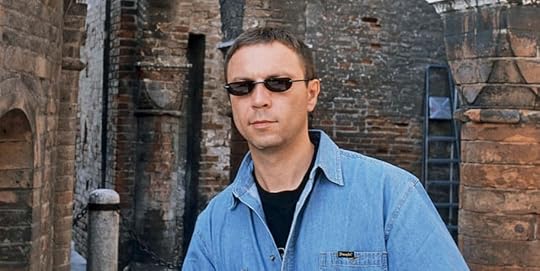
Russian author Victor Pelevin, born 1962
Comments
Post a Comment