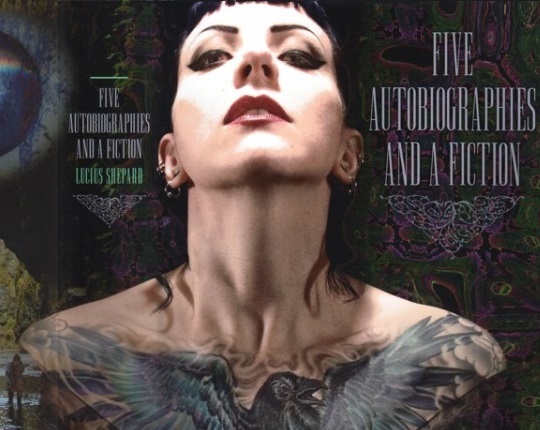
Five Autobiographies and a Fiction is an outstanding collection of six novellas by American author Lucius Shepard. There is also an introductory essay where Shepard describes how five of these fictions—herein called autobiographies—are various renditions of his past selves that might have been accurate accounts of his life if events had twisted in a slightly different direction.
Each one of these Shepard tales is a gripping snapper for readers who like their fiction jolted by a shock of the paranormal. For the purposes of my review, I'll focus on the first two shorter novellas from the collection:
DITCH WITCH
Shepard tells us he could have easily become a hustler and petty thief like Michael, the protagonist in this tale. On the opening pages, Michael is driving a Cadillac he stole from an older man he was living with in LA. He also snitched a pile of the man's cash to serve as a kick-start for his new life in Seattle.
At a rest stop near Sacramento, Michael picks up a skinny blonde teenager wearing a tank top and cut-offs. “She had milky skin, nice legs and sharp features that reminded him of photographs from Depression-era Appalachia and matched her hick accent.” She tells Michael that her name is Tracy and, once they're driving along the highway, joins him in taking several hits of his coke. “He felt that he was burning with indefinable brilliance and menace, that he had inhabited some nihilistic fantasy and become its outlaw Jesus.” Anyone who knows anything about Lucius Shepard when he was Michael's age (early twenties) recognizes just how close the author is to coked-up Mike.
Come nightfall in rural Oregon, the pair exit the interstate and eventually pull into a motel, the Elfland Lodge, on the edge of a pint-sized town. The oafish night clerk at the front desk hands Michael a key card for Room 120 and says, “It's out back.” He then adds, “Dude! Check out the elves. Those from which our establishment derives its name. The owner brought them back from the Black Forest. Believe me, they are not to be missed.”
Once out back, Michael spots a bunch of oddly shaped, painted rocks at the far end of the property. When he strolls across, followed by Tracy, he sees these are the elves the clerk was talking about—twenty in number, each about three feet tall, “disturbingly lifelike” and brandishing axes, long knives, and warty cudgels. “Some were hunched over, appearing to have been struck wooden and inanimate in the midst of a furious assault, while others leered at their companions as though anticipating a bloody result.” Knowing we are reading a Lucius Shepard tale, which nearly always veers into the paranormal, we can imagine what nastiness these “disturbingly lifelike” elves could get up to.
Tracy remarks, “Those things are wicked,” and asks Michael to go back to Room 120 with her. He tells her to go on ahead; he'll be along shortly. Tracy warns, “You stay out here, I can't be responsible. They got evil in 'em. You're just stirring 'em up, standing here and all. They'll hurt you. Or maybe worse.”
When Michael returns to their room, Tracy (who reveals her real name is Carole) is in a dark emotional state, as if the sight of those elves stirred her "inner witch." Over the next twenty minutes, they exchange heated words, and it becomes clear they share deeply troubled, emotionally abused pasts. Carole says, “We're the same people. You might be older than me, and you think you're smarter. But we been the same places, we had the same trouble. We understand each other.”
Michael says something that gets Carole even more upset. She hugs her knees, rocks back and forth, and begins singing tunelessly. He stomps out of the room and encounters . . . the elves.
Ditch Witch is one of the author's most harrowing, unforgettable tales.
THE FLOCK
“I was a big, angry kid, 6'2'' in the ninth grade, eager for the opportunity to unleash my anger, whether within the bounds of the game (football) or outside of it.” So speaks Lucius Shepard in his introduction. He goes on to explain that the two main characters in The Flock, Andy and Doyle, represent the two halves of his personality—Andy a bright, immature man-child, and Doyle, a vicious, near-sociopath.
I loved reading The Flock for a very personal reason: my own high school years, especially playing football, count as the nadir of my life. On reflection, I can almost not believe how totally "asleep" I was during those years—intellectually, spiritually, and socially. Of course, suffering through a terrible case of acne didn't help (an understatement). Thus, this tale of small-town mentality and high school football resonates deeply.
Shepard treats us to a story where Andy and Doyle must deal with the harsh reality of living as teenagers in rural, small-town USA, where high school football games are the biggest attraction and stir up the most powerful emotions.
True to vintage Lucius Shepard, there is also the inclusion of the paranormal, taking the form of thousands of grackles. “In our corner of South Carolina, grackles were called the Devil’s Bird, and not simply because they were nest robbers. They were large birds, about a foot long, with glossy purplish-black feathers, lemon-colored eyes, and cruel beaks.” For me, it is the perfect setting for the paranormal—occurring during the most important football game of the season, where thousands of fans flock to the stadium and Andy, Doyle, and the rest of the hometown team face off against their arch-rival, Taunton High, who wear purple and black uniforms with gold trim. What happens in The Flock bestows an expanded meaning to the word "gridiron."
Whether it's Michael’s emotional traumas or Andy’s small-town struggle, Shepard proves that the most terrifying ghosts aren't always the ones hiding in the shadows; often, they are the versions of ourselves we almost became. While these two tales serve as a powerful introduction to the collection, they are only the beginning of the journey. Shepard’s ability to "jolt" the mundane with the paranormal remains unrivaled, and I look forward to posting separate reviews on the other four novellas in the collection.

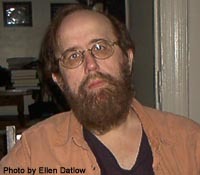
American author Lucius Shepard, 1943-2014
Comments
Post a Comment