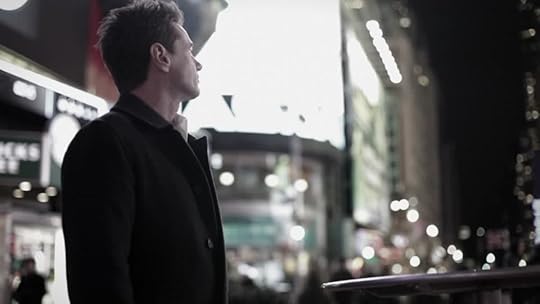
First published in 1978, Ladies' Man is an early novel by contemporary American author Richard Price (yes, the author of the recently released The Whites by aka Harry Brandt and also author of Clockers). Anyway, in this book Price does an excellent job capturing the loneliness and desperation of first-person narrator Kenny Becker, a thirty-year-old New York City door-to-door salesman. The novel is seven chapters long, each chapter titled for each day of the week, and the opening chapter (Monday) finds Kenny sharing his apartment with his good-looking girlfriend, La Donna, a clerk at a mid-Manhattan bank and aspiring singer of Dionne Warwick-style songs.
As a way of background, here is a quick note on Kenny's past: Before living with La Donna, Kenny relates how he lived with four La Donnas in the past six years - each one a heavy, bad relationship. And before that, he lived in what he calls "Kenny-Solo," that is, living alone in howling loneliness. And before that, Kenny tells us he lived with a bunch of guys, "Kenny Groupo," which he found disgusting and a continual violation of his privacy. We can ask: When did Kenny ever experience any happiness? Answer: We find out a couple of chapters later that he had a taste of happiness when he was known as "Kenny the Riffer," class clown and know-it-all wise guy back in high school.
There are spots of humor in the novel when Kenny makes caustic observations about what he encounters as he journeys through the urban landscape, but the tenor of Kenny's story is grim, very grim. Here is Kenny's reflection on Tuesday morning after a fight with La Donna: " But I trudged down Broadway, dragging my sample case to the bus stop. I was never so clear on the monotony of it all. And the sad fact was that I realized one of the reasons I didn't change channels was because everything else felt like a rerun." Later that same day, Kenny returns to his apartment and blows up in a rage when he catches La Donna using a vibrator. Humiliated and unnerved, La Donna vacates the premises.
Left alone, Kenny turns on the television to occupy his attention, noting how Jackie Gleason and the Honeymooners is one of his anchors. Then, tossing and turning, unable to sleep during the night, Kenny turns on the television again at 5:00 a.m. and becomes emotionally engrossed in a call-in show. A couple of hours later at breakfast, Kenny can hardly believe how much rage he experienced at one of the callers of the call-in show. Indeed, the more we read about Kenny, the more anger and rage we realize he has to deal with in his life.
One of the most telling parts of the novel is when Kenny runs into a couple of his high-school buddies, Donny and Candy. The three guys reconnect with their high school days; they even travel back to one of their old playground hangouts. Watching Donny and Candy play handball, Kenny reflects on their high school years: "It was over. It had been the best and now it was over and nothing had ever felt as good. We had peaked back then, and all we'd been doing since was dying."
We follow Kenny on his downward spiral. After a visit to a live porno show, Kenny has a realization: "And it hit me; I didn't feel anything anymore. I didn't feel anything. Nothing got to me anymore. I had to do that (masturbate at a live porn show) for anything to get to me. I was dying. . . . I was in desperate need of some clean beauty."
And Kenny finds some clean beauty at an uptown pick-up bar in the person of Kristin, who he smooth-talks into accompanying him to his apartment and then his bed. However, the next day when Kenny receives a phone call from Kristin, he ops not to see her again and rather ops to go back down to Times Square for another hit of live sex thrills. We get the feeling Kenny is a flesh-and-blood pinball rapidly bouncing back and forth between bumpers; for example: when he alone, he wants to be with a woman; when with a woman, he wants to be alone; and same thing with Donny -- he seeks out Donny's company, but when with Donny, he wants to be alone.
Let's pause and consider what the Danish philosopher, Søren Kierkegaard, said about what he calls the aesthetic life, that is, a life lived for the moment, flitting from one pleasure to another, a life of seeking out fresh sensations so as to flee from boredom; and as the aesthete seeks ever more intense sensations to quench their thirst for enjoyment, they becomes jaded to the simple joys of everyday life. This description seems to certainly fit Kenny like a custom-made Italian suit.
But are we being too harsh in this judgment? Toward the end of the novel, Kenny reveals to Donny (and to us as readers) how, as a kid growing up, he was on the receiving end of serious emotional abuse at the hands of his mother and father. Additionally, Kenny acknowledges he needs help. As readers we concur. Kenny does indeed need help, perhaps from a therapist, perhaps from a teacher at a meditation or yoga center, perhaps from some other source, but Kenny really needs help in making the transition out of the trap of his present life, a transition enabling him to get a grip on himself and lead him to a more harmonious and wiser mode of living.
Anybody interested in the psychology of personal identity and the transition from boyhood to manhood would do well to give this work by Richard Price a careful read. Ladies' Man is a serious novel treating a serious subject head-on.
Comments
Post a Comment