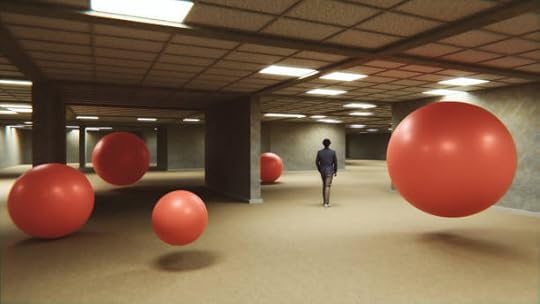
Member by Michael Cisco stretches across cityscapes of the weird and twisted, from Thomas Ligotti–style dread to the elastic logic of 1950s black-and-white cartoons—where a body flattened by a steamroller springs back to dance—while threading through the bureaucratic nightmares of Franz Kafka and the delirious absurdities of Mikhail Bulgakov, a novel that doesn’t just bend the mind, but quietly erodes the idea that the self was ever in control.
Member is a 356-page work of unique weirdness, a novel whose world is so singular it requires a glossary at the back to explain its various components. An example from the glossary: "Tape Guns -- guns that fire tapes of written parchment by squeezing together two powerful cylindrical magnets." And this weird world is encountered by a narrator we eventually come to know as Mr. Thanks. Cisco offers just enough narrative structure as we follow Mr. Thanks on his odyssey from first page to last, but never enough to provide solid ground beneath our feet.
To share a batch of direct hits from our intrepid narrator’s oddball journey, here’s a highlight reel:
OPENING REFLECTIONS
“I'm dry. Dry dry dry dry dry dry dry. Dry as they come. This is the story of how I accidentally recruited myself into the cosmic game of Chorncendanta. I don't know the story yet. I have the feeling it's going on.”
These are the opening lines of the novel. The first confrontation Mr. Thanks faces is with himself: what type of person he is and what he wants out of life. By judging himself as “dry, dry, dry,” he suggests a life that has become a vast desert of stale routine, where every grain of sand sits precisely where the manual says it should. I imagine Mr. Thanks as a thirty-five-year-old bean-counter, the perfect organization man, content to function as a gear within a colossal machine.
His accidental recruitment smacks us as the ultimate game-theory trap, a system so all-embracing that merely existing within its field amounts to entry into the game. All this suggests he is living in a Skinner box so vast he cannot see its sides or top, where any so-called free choice is simply a predictable response to stimulus—little more than a mouse searching out the cheese—making him both victim and agent of his own entrapment.
This Cisco novel resonates with me in a profound way. Growing up during the 1950s in a bungalow on the New Jersey shore, the TV was always on. There was no escape. Like the game of Chorncendanta, you didn’t have to pay attention to the screen to be affected by it—the house itself was already vibrating with its frequency.
THE MISSION
Following a freaky encounter with a stranger during a nightly stroll through the streets of an unnamed city, Mr. Thanks finds himself carrying what appears to be an ordinary duffel bag but proves to be anything but: it contains magic spells, prizes, and, as he eventually learns, a portal to another world. Just as he is about to enter his apartment, a large, hulking man executes a judo-like jerk that snaps his larynx back toward his spine. The thug then assigns Mr. Thanks the task that will prove central to the novel: take on the role of courier and deliver the bag and its contents to the construction site. “You don’t stop, you don’t rest, you don’t do nothing else but that.” The thug lands one final blow to Mr. Thanks’s stomach and disappears.
Now that the narrator has been given his role as courier, he is no longer merely drifting within the cosmic game of Chorncendanta—he is bound to it. The bag serves as a perfect Cisco object: its ultimate purpose remains unknown, yet it exerts absolute force. It gives Mr. Thanks direction and compulsion—he knows where he must go and what he must do.
YOU’RE NOT IN KANSAS ANYMORE
When Mr. Thanks and his bag arrive in Chorncendantra, he immediately finds himself immersed in an alternate reality so weird and gonzo that it defies ordinary perception: a human head the size of a whale, a rifle that shoots tape at Emitters—immense glob-beings that live on information. And someone informs Mr. Thanks that an Emitter doesn't eat you like a lion eats you, but it is no fun at all. Mr. Thanks reflects: “In the street you can't fully distinguish between the people and the machines, although it's not as if they are bound together. Their motions however are exactly coordinated, carrying parcels of momentum from here to there, object to object.”
Mr. Thanks is exhausted, yet a voice in his head insists: “All bodies are machines, and that's the way it has always been, although the machines change. It's just as wrong to see humanity as a mob as it is to see it as a group of individuals or as a collection of unique souls with an inside and an outside. Human beings are distributed creatures.”
Ah! It appears that, like Michael Cisco himself, Mr. Thanks is well versed in the philosophy of Gilles Deleuze, where “distributed creatures” signals a radical dismantling of the traditional notion of the individual self in favor of a being dispersed across networks of machines, social flows, and historical forces. Reading Member will provide any reader with an ample supply of ideas for serious philosophical reflection—almost like reading Anti-Oedipus at triple speed.
WORKERS OF THE CHORNECENDANTRA WORLD, UNITE IN CRAZINESS
Mr. Thanks beholds many instances of mind-boggling idiocy, but none tops a scene that feels ripped from a 1950s black-and-white cartoon: Operationals—human worker bees—frenziedly constructing a grotesque, ever-shifting structure. “The Operationals charge the structure in a frenzy. For a moment I imagine they're going to tear it to pieces with their bare hands, like a wave of attackers battering on the ramparts of a besieged castle. A woman a few dozen yards from me goes to an orderly pile of steel girders, rolls one over and picks it up in the middle, carrying it against her hip as she runs up the streaked concrete ramp. I see others doing the same, upending girders as if they were no heavier than curtain rods and slamming them into place, while one squats nearby to secure them, driving in the huge bolts with bare hands. It's unreal—the human body can't generate that kind of force.”
Why does Mr. Thanks, bag in hand, continue in his role as courier in such an absurd world? He persists—even as flashes of moral awareness surface, as when he learns that during the Festival of Technical Laborers the workers “celebrate” by working triple shifts. He reacts in shock: “Triple shifts? You mean they celebrate by being made to work three times harder? That doesn't seem right.”
Member offers an endless source of fascination. Page after page, I found myself wondering how much of what Mr. Thanks experiences is a consequence of his being a weightless, ungrounded being—very much like Low in The Narrator—and how much reflects the structures of our own contemporary world.
One thing is certain: this is a novel I will return to again and again, not to master it, but to deepen my sense of what it means to be alive in our human, all-too-human world.
Comments
Post a Comment