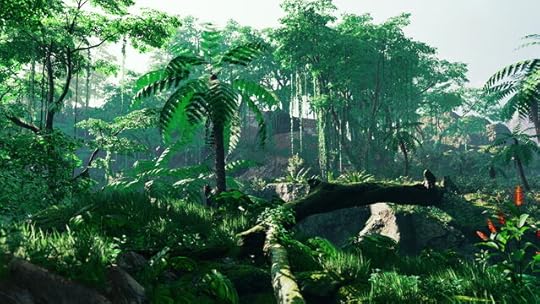
Surrender, an eerie, frightening tale—Lucius Shepard at his darkest and sharpest.
"I've been down these rivers before, I've smelled this tropical stink in a dozen different wars, this mixture of heat and fever and diarrhea, I've come across the same bloated bodies floating in the green water, I've seen the tiny dark men and their delicate women hacked apart a hundred times if I've seen it once."
The above is the grisly opening line for this 24-page novelette narrated by a jaded American journalist by the name of Carl, who's seen it all in war-torn countries like Cambodia, Nicaragua, Vietnam, Laos, and El Salvador.
We're in Guatemala, and Paul DeVries, Carl's journalist buddy ten years his junior, urges Carl to make their way to a shantytown at the edge of the Petén rainforest, since rumors are buzzing of strange happenings. Carl agrees, and once in town they bump into a tall, attractive Canadian nurse with light brown hair named Sherril. It turns out Sherril knows of a jungle path leading to the hotbed of all those wacko rumors—the farm.
The trio sets off at night and, after two hours of steady hoofing, reach the farm. They approach cautiously, on their stomachs. There's a field of agave and, in the distance, a white stucco building—and no fewer than fifty soldiers training their rifles on the agave field. Very odd.
Carl, Paul, and Sherril have seen enough. They're just about to retreat when Carl hears the distinctive click of an automatic weapon and an order delivered in Spanish. Moments later, the three are herded roughly through the field and arrive at the white stucco building. Carl, forever the cynic, remarks, "Laid out in the dirt beside the door was one of your basic Central American vistas: a row of bullet-riddled naked bodies."
Once inside, Carl relates another standard for the CIA: “your sadistic officer, this one a major named Pedroza who would have scored high in a General Noriega look-alike contest: the pitted skin, the vaguely Oriental cast to the features . . . his face had the cruel sleekness of someone who had indulged in torture and enjoyed it.”
Pedroza fires off a few questions and is on the cusp of getting physical, especially with lovely Sherril, when a distinguished older man enters the room. Carl recognizes this gentleman as Duncan Shellgrave, a VP for a leading American bank in Guatemala. Shellgrave tells Pedroza to leave and then informs Carl and the others they will have to remain for a while in the room, since “we're having a little problem.”
What problem? The answer becomes clear when the sound of gunfire and screams rings out—“throat-tearing screams of pure agony and fear.” Shellgrave bolts for the filing cabinet and pulls out a large stack of papers. Carl spots the word mutagenic, but Shellgrave yanks the papers away. Carl has had enough—he shoves Shellgrave to the ground and continues reading. Shellgrave heaves himself up and comes at Carl with his fists. Carl kicks him in the stomach, and the bank VP goes down hard, smacking his head on the concrete floor.
All three gather close together and begin reading. Horror. Unbelievable horror. They read of a project in the making for the past twenty years. Sherril, who has a strong background in biology, explains in disbelief: “Mutants. The food's worked terrible changes on the second generation. The brain's degenerated . . . I think they've become nocturnal . . . They're killing them. They've stopped feeding them, and they can't eat anything else but the plant they grow here.”
You'll have to read this riveting Shepard novelette to find out what happens to the trio, the mutants, and (gasp) Major Pedroza. Let me shift to the philosophical.
A MORE COMPLETE VISION THROUGH SCIENCE FICTION
“I'm sure that reading this as fiction, which is the only way I can present it, some will say that by injecting a science-fictional element, I'm trivializing the true Central American condition. But that's not the case.” Similar to Carl, Lucius Shepard spent large swaths of time in Central America, from the jungles of Guatemala and El Salvador to the teeming, poverty-stricken cities of Honduras and Nicaragua. He knows that when it comes to the dire extremes of life unfolding for men, women, and children in this part of the globe, inserting tropes from science fiction, horror fiction, and/or fantasy can serve to clarify and highlight the intensity of their suffering.
EVIL AS THE UNIVERSE'S PRIME FORCE
Carl and Sherril squat in a cave, trapped for the moment by legions of mutants. Carl begins to tell Sherril stories of heroes and courage—stories that once gave storytelling a good name. So it is with a strong sense of irony that Carl admits: “Although I'd convinced myself that I'd given up on my ideals a long time before, I believe it was then that I utterly surrendered to the evil of the world.”
Lucius Shepard wrote Surrender in the late 1980s, around the same time as the publication of Blood Meridian by Cormac McCarthy—both works of fiction soaked in evil; evil so fierce, so harsh, so all-pervasive that it seems less a human trait than the prime force of the universe, a vision harkening back to the ancient Gnostics.
EROS AND THANATOS
“Although I didn't recognize it at the time, I was learning that you can fall in love through hate, by being with someone in a crucible of a moment when everything else is dying and the only thing left is to try to live.” Carl and Sherril return to live together in the Rockies, not far from Calgary in western Canada. He muses: “Life is sweet. We've got money, food, a future . . . It's good to make love, to walk, to smell the wind and watch the sun on the evergreens.”
In this way, Lucius Shepard has given us a tale not only of horror and death, but also of love and tenderness—a tale spanning the full spectrum of human emotions.
CENTRAL AMERICA IS CENTRAL
“Central America isn't just Central America. It's what's happening, it's coming soon to your local theater, and if you think I'm overstating the case, if you don't see the signs, if you haven't been taking notes on the inexorable transformation of the Land of the Free into just another human slum . . . well, that's cool.” It is now 2026. Surrender could be judged as Lucius Shepard at his most prescient.
I can't recommend Surrender highly enough, both for Lucius Shepard fans and for those new to his fiction. I will go further: if you haven't read any Lucius Shepard, this is the work to explore first. Eye-opening and mind-expanding.
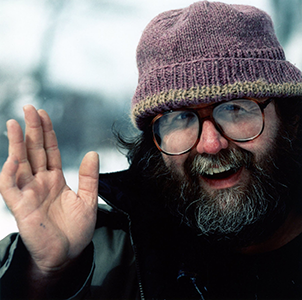
American author Lucius Shepard, 1943-2014
Comments
Post a Comment