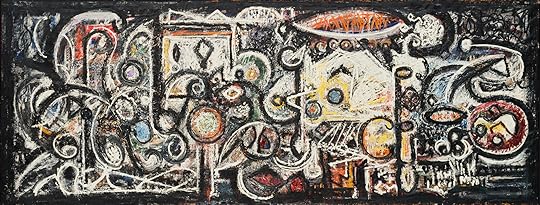
New Weird fiction reaches its zenith in The Narrator by Michael Cisco, a novel that tests a reader’s willingness to sustain estrangement, verbal intensity, and the pressure of the densest atmospheres—where language itself dreams, slides, and slices into uncanny combinations.
A riveting tale of war, told through the eyes of a recent graduate of the College of Narrators, one Low Loom Column, who has been drafted into the army to serve as both fighter and chronicler.
This is a long novel—440 pages divided into seven chapters. To offer a strong taste of what a reader will encounter, I will focus on a number of highlights and scenes from the first two chapters, including passages that showcase Michael Cisco’s vivid language.
COMPLETE HORRORSHOW
The opening chapter takes place in Tref, a city of “vast boulevards where the air is never still, flooded with sparkling bicycles that shoot, dart, and veer in shoals.” And the more Low sees of Tref, the more harrowing and ominous it becomes. At one point, he meanders into the commercial district: “Representatives of the Embalmers’ College wander among aisles of corpses, heaped in pyramidal piles. They’re soft and spotty like overripe fruit; the students and masters pinch, sniff, and squeeze with judiciously long faces and expertly seeing eyes. Barrels of hands, feet, and genitals quiver as heavily laden carts rumble by.”
“An army is a horror. It’s a horrible thing.” These are the novel’s opening lines. However, what Low beholds in Tref speaks of a society in which the human body has lost any sense of decency or integrity—a society where violence and brutality are the given, the norm. Recognizing these gruesome facts, an army going to war can be seen not as a contrast to peacetime existence, but as an extension of ugly, ghastly, day-to-day living.
ELDRITCH EDEKS
“The Edek's head swivels in my direction as she goes by, and the fierce thrust of her gaze nearly knocks me against the wall. I rub the sparks from my eyes, and when I look again, the two are gone. Too late—she saw me.”
Cisco’s novel is steeped in the creepy supernatural. The Edek possesses the power to observe, to witness—and that act of seeing serves as an enforcement of imperial will. Once seen, Low is effectively sealed off from desertion, permanently marked within the machinery of a vast and impersonal bureaucracy. An additional eerie dimension deepens the effect: not only does an Edek wear “a close hood of dun cloth with two holes for her eyes, fitted into a bandage of thick gauze tape wound many times around the long neck,” but she is not entirely autonomous. Edeks are female creatures who require a human handler.
A WIDOW STUDENTS CALL CANNIBAL QUEEN
Low is attracted to a widow—a tragic presence dressed in black—and pays a visit to her Gothic-like abode, where the two develop a romantic relationship, of sorts. But on Low’s second visit, the Girl (the author’s capitalization) who lives with the widow entices him with her nudity. Low flies to her bare, enfolding arms. This scene underscores Low’s lack of a moral compass—he is a passive, weightless character, one who does not act so much as is acted upon.
Also worth noting: Cisco frequently adds a grotesque, haunting flourish. Here is the way the canopy above the widow’s door is described: “A bronze canopy, its outer ring studded with round baubles, and topped with two life-sized bronze foxes, mirrored, creeping along the edges of the canopy with the far forepaw raised and matching sidelong looks. A human expressiveness has been inharmoniously grafted onto their faces, and the resulting look mingles derision, rapacity, idiocy, and yawning in equal parts.”
ARMY ABSURDITY
Low marches over foothills as part of a company of about seventy soldiers under the command of Captain Makemin. In truth, these men strike the reader as a bizarre ragtag posse rather than anything resembling a proper army unit. Their numbers include Clappers: “When soldiers fight with their bodies the Clappers fight with their spirits by means of complicated interlocking clapping and chants to Eihoi the Wild Horse.”
And then, along the trail, when they encounter an insane asylum, Makemin does not hesitate to make the inmates part of his advancing column. He proclaims, “I am here to recruit.” A sergeant asks incredulously, “Surely you don’t propose giving these people arms?” But Makemin has already made up his mind: “I’m damned if I’ll go off short-handed.”
A very funny scene—one that makes the bloody ambush Makemin’s company suffers shortly thereafter all the more horrific and chaotic.
THE REDEEMER, THE REVOLTING
Following death (about twenty of their number) and wounds, Makemin’s company presses on. Then the miraculous—a cry rises: “The Redeemer’s coming!” Oh yes, the Redeemer’s army is on the horizon: “The Redeemer is unique, with so many engines and so many guns, all superlative numbers—its battery can, on one side, level a town in minutes.” Cisco brings out the grotesque here: with such formidable power on your side, what real need is there for Makemin’s rabble?
Speaking of the grotesque, Cisco elaborates on the armor worn by the Redeemer’s soldiers, the Ghuards, concluding with: “The legs are thick pistoned trunks with ponderous hinges at the angles, and incongruously prim pointed feet. They pull along in swarms of flies—their hindquarters and thighs are caked with excrement, as the Ghuards exhibit a marked disinclination to divest themselves of the armor once they’ve got it on.”
Ghastliness without end with this elite, armored bunch: “Behind a rampart of chain-bound barrels they are smashing their screaming prisoners to paste in massive iron mortars, or pulling them apart in demoniacally gleeful tugs-of-war.”
With The Narrator, Michael Cisco has given us a genuine tour de force of weird literature. Yet there is something more. As Jeff VanderMeer observes in his incisive Introduction, “Yet the true wonder of The Narrator is that in addition to the haunting and unique marvels of the supernatural on offer, the novel is also an extended treatise on the negation of meaning that is war.”
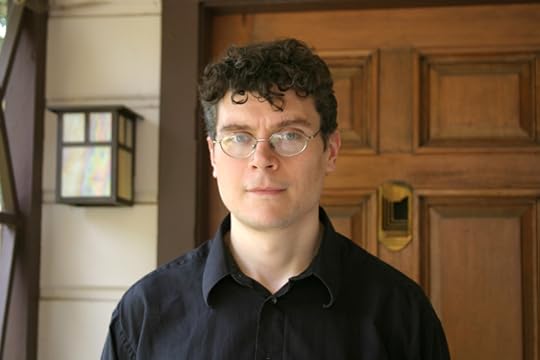
American author Michael Cisco, born 1970
Comments
Post a Comment