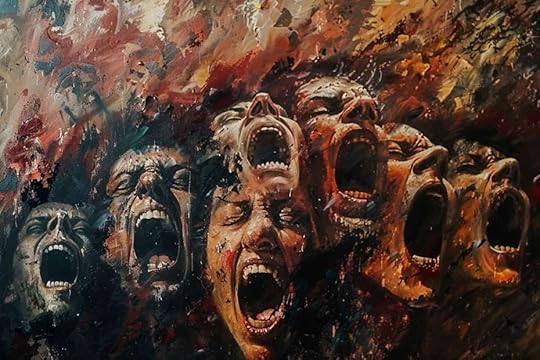
Daniel F. Galouye's 1968 A Scourge of Screamers (also published as The Lost Perception) is a post-apocalyptic political thriller set in 1997, fifteen years after a global nuclear war triggered by the accidental launch of a missile when a Russian officer became a Screamer (the author's capitalization). And what is a Screamer? Someone who has suffered a catastrophic mental explosion, as if the mind had been set on fire by the equivalent of a thousand doses of LSD, propelling the victim into an unending spasm of screams.
The human population reels from the Screamer phenomenon. Many millions of men and women at every point on the globe are now Screamers. And society's reaction? Isolation institutes, Screamer Pickup Squads, emergency sedation kits complete with hypodermic syringes to silence victims—all coordinated by a newly formed Security Bureau (SecBu) wielding worldwide power in the wake of governmental collapse.
As if living in a world of half-demolished, rubble-strewn cities filled with Screamers were not enough, there are now human-like aliens roaming the streets. SecBu blames these extraterrestrials—the Valorians—for the Screamer plague. According to the bureau, the Valorians unleashed the Screamer phenomenon upon humanity as the first step in taking over the planet.
The novel's protagonist, Arthur Gregson, served as a project engineer in charge of systems aboard a US space station. A few chapters in, Gregson himself becomes a Screamie and is sent to an isolation center. “It was as though a fissure had opened into his brain to admit all the hallucinatory terror and pain ever spawned in a deranged universe. At times his entire being seemed to expand vertiginously through unknown dimensions to encompass all time and space, while the distant, fiery stars burned like embers into the weft of his soul.”
After two full years of agony, Gregson eventually returns to health, a most unusual event since only one in a thousand individuals ever recovers. Soon thereafter, Gregson receives his next assignment: to undergo specialized training at SecBu's top-secret center in Paris, where he will learn to use his new post-Screamie psychic powers, including telepathy, long-distance viewing, precognition, and the ability to read other people's minds. However, Gregson is in for a series of shocks. He comes to understand that the Screamie plague might not be caused by the Valorians at all, but rather by the Earth entering a field of radiation from across the universe. Additionally, he realizes that nearly all the top SecBu officials are Screamie survivors possessing these incredible psychic powers.
I will leave how Galouye's thriller unfolds for Gregson and the human population for each reader to discover. A Scourge of Screamers has received a number of negative reviews, an assessment with which I strongly disagree. Rather, I found the tale riveting, philosophically stimulating, and nearly impossible to put down—I eagerly kept turning the pages, fighting off sleep until I reached the end.
Turning to the philosophical, here are a number of questions we would do well to keep in mind as we progress through the chapters. What is our “normal” human perception shutting out? And to what extent is this limitation a consequence of culture? I recall anthropologist Colin Turnbull noting how the pygmies of the rainforest could read, in astonishing detail, the many signs of the various animals that had passed through a particular section of the jungle. Turnbull relates that, as a Westerner, he could read nothing at all.
With many years of meditation practice, I've become keenly aware of my breath in all its phases, an ability that enables me to rest easily in silence, solitude, and stillness. Quite different from many in our modern society who are barely aware that they are breathing. Likewise, through physical theater training, I've developed a heightened kinetic sense I did not possess in my younger years.
If our brains evolved to filter out 99% of the world around us so as to prevent overload, are we, in many respects, blind to the richness our five senses offer? Can we train ourselves to become more perceptive?
If one group possessed what are conventionally viewed as paranormal abilities—things like the telepathy, long-distance viewing, precognition, and mind-reading powers Gregson and the leaders of SecBu possess—should they use these abilities to their own advantage and at the expense of the remainder of the human population?
If the agony of a Screamie is, in effect, an evolutionary birth pang leading to heightened awareness, is such suffering desirable? In our everyday lives, are we willing to relinquish our current beliefs about ourselves and the universe in order to transform into something deeper, more profound, and more aware?
Is surrendering our freedom as individuals for safety and comfort ever justified? This question looms especially large when we encounter a society inclined to forfeit critical thinking and simply believe what it is told.
In the end, A Scourge of Screamers is not merely a post-apocalyptic thriller but a daring meditation on consciousness, conformity, fear, and the frightening price of awakening.
Comments
Post a Comment