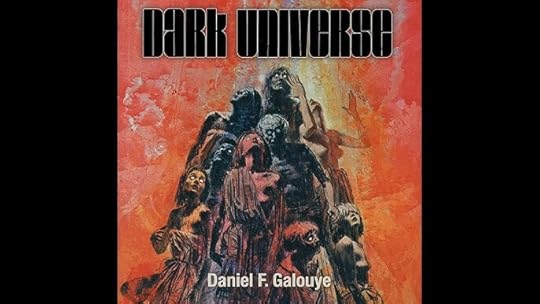
Provocative, intense, fierce, extreme—Dark Universe, the 1961 post-apocalyptic novel by Daniel F. Galouye, is the kind of book that doesn’t end when you turn the final page. Its characters, images, and ideas linger, unsettle, and expand in the mind. Galouye’s meticulously detailed world-building is nothing short of spectacular. This much-overlooked classic of ’60s SF deserves a place in the hands of every serious reader of speculative fiction.
We follow Jared, the tale’s twenty-something protagonist, as he sets off on a quest through his deep underground world in search of the truth behind the nature of light, radiation, and the eerie monsters threatening his people. Jared is part of the Survivor clan, living in absolute pitch blackness on the Lower Level (author’s caps) within a vast network of caves. There is a competing Survivor clan on the Upper Level who, like Jared and his Lower Level people, rely on heightened hearing and bat-like echolocation by clicking stones together. And there is still another group of humans in this immense subterranean labyrinth: the Zivvers, who have mutated to the point where their poor hearing is compensated for by a keen ability to “ziv”—that is, to see in the infrared spectrum.
Jared's journey from his world of darkness into light has often been likened to Plato’s allegory of the cave. However, there’s a critical difference. In Plato’s tale, the captive who escapes the shadow images within the cave and emerges into sunlight experiences great joy, recognizing he is beholding the sun, the true source of light. This makes abundant sense since he has been using his eyes all along. But Jared has spent his life maneuvering through pitch blackness with his ears attuned to his click stones. And when he reaches the outer world of sky and sun, he experiences nothing resembling joy; rather, he is gripped by confusion and terror. But this turns out to be only Jared’s initial step; the young man is in store for many more revelations.
With Dark Universe, Daniel F. Galouye presents us with a profound observation: our human journey is a series of openings into the light, a greater appreciation of the depth and richness of what life holds for us. Through one lens, the novel explores themes of superstition versus science, ignorance versus the true nature of reality.
This accords with my own experience. I had my first opening when I took a philosophy course in college. Encountering the world of ideas, I could detect that the reality I had been exposed to throughout my childhood and adolescence—television, mindless competition, mocking others—was small, cramped, and mentally constipated. I spent the next four years voraciously reading philosophy, vowing I would never fall back into the darkness constructed by a consumerist culture dedicated to entertainment.
But this was only the beginning. Through a deeper appreciation of literature and the arts, my mind and emotions became more refined and more attuned to the subtleties and complexities of what it means to be human. And then, through the practice of yoga and meditation, my mind and body underwent a further awakening.
This is to underscore that Galouye has an accurate appraisal of human life. We do not escape the cave once—we leave it again and again—and each time we discover a more complete sphere of daylight. So, the question the author poses is this: What cave are we currently inhabiting, and what are we planning to do to emerge from the darkness? In this way, Dark Universe is not only about Jared’s odyssey, but our own.

American SF author Daniel F. Galouye, 1920-1976
Comments
Post a Comment