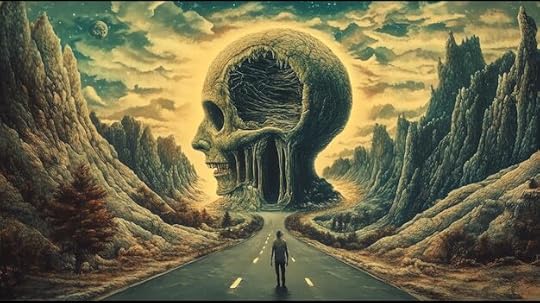
Deathhunter is not a science fiction novel in the conventional sense. Deathhunter is a weird novel. A very weird novel.
I suspect a number of readers have given this Ian Watson novel a low rating since they assumed Deathhunter was written in the spirit of Brian Aldiss or Philip K. Dick. It is not. Rather, it is written in the spirit of Michael Cisco and Jeff VanderMeer, two prime authors associated with what is termed the New Weird.
We are plunged into a post-nuclear England as we follow Jim Todhunter (Tod in German means death) traveling to Egremont on a new assignment as a guide for the dying in the House of Death. Shortly thereafter, during an outdoor ceremony honoring Norman Harper, a poet and one of the guiding lights of the institution, Jim witnesses something completely alien in this valley community — a man pushes roughly through the crowd, points a gun at Harper, and shoots him in the neck and heart.
What follows is bizarre — and for very good reason: this entire society has banished violence. The people at the ceremony are almost at a loss as to what to do with a murderer. Peace Officers “positioned themselves around the killer like chess pieces checking yet unable to capture the king.” Eventually, they lead the murderer away.
The House of Death’s plan of action is simple: since he is a recent arrival — an outsider in Egremont — Jim will guide the murderer, Nathan Weinberger, a former guide who is himself dying of cancer. And, as it turns out, Weinberger lets Jim know he had very good reasons for murdering Harper.
Weinberger's reasons revolve around his experimenting with death via a sophisticated contraption designed to catch death itself, which, for him, often manifests as a small, flickering red presence. As kooky and outlandish as it might sound, Jim is intrigued and has his own reasons for going along with Weinberger's future experiments to hunt down death.
Since Jim, in his official capacity as guide, has been given a free hand with Weinberger, he is able to move Weinberger’s creation — a waterbed and various electrical contraptions enclosed within a large plexiglass box — into the basement of the House of Death so the pair can carry on in secret.
What happens next, step by oddball, spooky step, is for each reader to discover while turning the pages. At this point, I’ll shift to a batch of philosophic reflections. SPOILER ALERT: I’m obliged to include a number of vivid scenes from deep within the novel.
EGREMONT AND THE HOUSE OF DEATH
One prominent voice in Egremont tells Jim: “All that we've blessedly won after years of stress and fear! And what better way to bring this society down than to infect everyone with the fear of death? The old terror! Only a beast would do that! A devil!” Such words bring to mind the ancient Greek philosopher Epicurus, who likewise urged his followers to move beyond the fear of death: “When we exist, death is not present, and when death is present, we no longer exist.”
However, huge differences separate Egremont from Epicurus. The Greek philosopher created his garden community to cultivate philosophic reflection, self-knowledge, friendship, simplicity, and disciplined living. Egremont and the House, in contrast, regulate an entire society — beginning at an early age — through the constricting of emotions and perceptions so that everyone remains cheery, saccharine, and entirely superficial. Nothing dark, brooding, or containing even a tincture of the existential or tragic. And what type of art and literature does such a society produce? Lollipop kitsch all the way.
RED BAT-LIKE CREATURE
Following the first foray in Weinberger's contraption, when pressed by leaders within the House of Death bureaucracy, Jim says defiantly: “I believe I saw Death. It was like a bat. It was like a huge moth, though there was nothing flimsy about it! It had big crystal eyes.” This is surely the comic high point of the novel. And the reaction of these officials? Considering they have all been living in lollipop Egremont, their constipated response is entirely predictable. Jim hallucinated — a product of pure fantasy.
THE THINKING MIND
At one point during Jim and Nathan's most extensive out-of-body journey, they encounter “a lucid, shining emptiness which was very like a negative of space: a white void.” And Jim's reaction? “By now Jim's mind was willing the blank void to be something. . . . No space could be utterly unbounded, extending forever.”
Jim exhibits the conventional thinking mind, especially the Western analytic mind — forever projecting, conceptualizing, and constructing. He lacks training in meditation or practices like Yoga Nidra, where one moves beyond conceptual thinking to merge with what Buddhists call emptiness and ancient yogis term being-consciousness-bliss.
MAGIC THEATER
Echoes of Hesse's Steppenwolf when Jim and Nathan come upon a long rococo hall lined with many doors. They open the doors one by one and discover all sorts of different worlds. Weinberger remarks: “Sets of fictions. Imaginings. Free creations. Not hells or purgatories, but inventions. Folk inventions, personal inventions.”
We are given the sense that what the pair discovers behind the doors has more to do with their own projections and ways of seeing than anything objectively “out there.” The idea that language and culturally conditioned categories serve as profound filters shaping human experience is an abiding theme throughout Ian Watson’s fiction.
THE ANGEL
Jim and Nathan are in for a surprise. An angel appears in the hallway and has the pair take a seat so she can explain a thing or two — after first breaking out three glasses and a bottle of whiskey. One especially provocative explanation:
“Unspace, Jim, is the realm of the infinite sharing imagination where you envision worlds and domains as an act of creative genius. It is where you will never be alone, since all have access to each other. It is where you give whole worlds to others, for adventure and enlightenment and joy, and even for terror — which is a kind of fearful joy — and others in turn give these to you. It is the ultimate place of free creative energy, common to all beings. You would soon learn to open all those doors in full awareness, till you had no need of doors at all — though you might like to keep them on as a useful convention. Like a rhyme scheme.”
Now the two men surely have much to think about when they return from this extraordinary adventure.
THE FINAL WATSON TWIST
The final chapter of Deathhunter features an incredible twist, one that I suspect most readers will not foresee. I certainly didn't anticipate such an ending. And I certainly will not spoil it by providing details. However, what I can say is that Ian Watson brilliantly brings together elements of unstable realities, New Weird grotesquerie, and metaphysical speculation.
Deathhunter is a short novel — barely 175 pages — but a must-read for any fan of speculative fiction or weird fiction.
Comments
Post a Comment