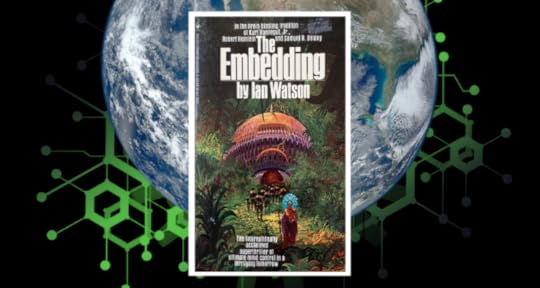
Ian Watson’s 1973 novel The Embedding is a profound exploration of language, culture, power, and the extraordinary efforts undertaken to extract and expand what it means to be alive. It is also a disturbing, unsettling, and, at points, shocking novel. Ultimately, however, The Embedding proves a rewarding read — a compelling tale that steadily gathers momentum, propelling the reader to keep turning the pages.
Watson provides four narrative threads (outlined below) that he masterfully braids together to create a tale that gradually takes on the cast of a high-stakes thriller.
Laboratory in England — Chris Sole, one of the novel’s major protagonists, is a linguist conducting research on young children with the aim of unlocking a deeper form of language embedded within English itself. What might initially appear innocent is, in fact, highly unethical: the children are plied with powerful drugs and confined to a secret basement section of a small rural hospital — a glass-enclosed room the size of a schoolroom, sealed off from the outside world. The researchers’ justification: the children are third-world orphans rescued from blighted poverty.
Brazilian Project — Charlie Faith is one of many American engineers engaged in the construction of a series of dams designed to create a colossal water system so vast it can be seen from the moon — a kind of North American Great Lakes embedded in the Amazon jungle. But the undertaking faces formidable challenges, among them harassment from left-wing guerrillas.
Brazilian Rainforest Tribe — Several dozen miles downriver from Charlie Faith’s headquarters in Santarém, deep in the Amazon jungle, French anthropologist Pierre Darriand — a former friend of Chris Sole — is studying a small indigenous tribe, the Xemahoa, as they practice their rituals and await the birth of their messiah.
Aliens on a Mission — In deep space, an immense alien spacecraft analyzes media broadcasts from Planet Earth. The aliens eventually dispatch what appears to be a compact flying saucer to Earth’s surface to meet with an international delegation.
The Embedding is overflowing with ideas revolving around linguistics, anthropology, altered states, cultural bias, geopolitics, and, of course, first contact with highly intelligent aliens — all within 250 pages. Here are a number of themes that any serious reader of speculative fiction will find absolutely fascinating.
WESTERN NOTIONS OF PROGRESS / THE DAM PROJECT
Charlie Faith reflects on the rainforest: “A million trees. A billion trees. Who knew the number? Hardwoods, mahoganies, cedars, steelwoods. Silk-cotton trees and garlic trees and chocolate trees. Balsa, cashews, laurels. So many trees. So much land. And so much water. All useless to mankind, up till the present.”
The events of the novel take place in 2002 or thereabouts. For hundreds of years, this has been the dominant Western approach to land and nature: they exist for the taking, exploitation, and conversion into profit — a worldview undergirded by Western systems of logic and monotheistic religion.
Charlie’s assistant, a well-educated Brazilian, thinks of Charlie as the typical yanqui — a representative of American corporate exploitation, encroaching upon his country and destroying everything in its path — indigenous peoples, plant life, animal life — for one ironclad reason: ensuring that massive amounts of wealth continue flowing northward.
Reading between the lines, we detect that this prototypical Western mindset pervades nearly all the Westerners in the novel, from the researchers at the hospital in England to those entrusted with negotiating with the aliens.
TRIBAL LANGUAGES / RAYMOND ROUSSEL'S SURREAL POEM
Pierre reports that the Xemahoa tribe possesses not one but two languages, what the Frenchman calls Xemahoa A and Xemahoa B. Xemahoa A is the language all the tribespeople — men, women, and children — use when engaging in everyday activities.
Xemahoa B is something quite different. “Their myths are coded in this language and left in safekeeping with the Bruxo (the tribe’s shaman). The Deep Speech and the Drug-Dance free these myths as living realities for all the people in a great euphoric act of tribal celebration — to such a degree that they are all firmly convinced that the flood is only a detail in the fulfillment of their own myth cycle, and that the Bruxo, and the child embedded in the woman’s womb in the taboo hut, will in some as yet inexplicable way be the Answer.”
Pierre goes on to link Xemahoa B with the language of embedding in French author Raymond Roussel’s surrealist poem New Impressions of Africa. He even informs Chris Sole that, after taking the tribe’s drug used to access Xemahoa B, he can suddenly understand in detail all of the embedding in Roussel’s otherwise impenetrable poem. This is because, Pierre surmises, Xemahoa B is itself an embedded language hidden within Xemahoa A. In other words, Xemahoa B and New Impressions of Africa share a similar embedded structure and status.
New Impressions of Africa also comes into play in the English hospital. In conversation with an important American visitor, Chris Sole uses Roussel’s poem as a way of explaining the dynamics and goals of his experiments with the children and embedded languages.
LANGUAGE AS WEAPON / LANGUAGE AS PRISON
Deep into the novel, outside his home near the hospital, Chris Sole looks around. “The familiar things were at the same time infinitely strange and fresh. They had taken on an unsettling double life . . . The house, as well as being a house, was now a giant red box of plastic bricks. The car was a Volkswagen saloon — and also a great plastic and glass spheroid of no very obvious function.” Sole is no longer grounded in the Western world of reason, data analysis, and statistics; his mind, as they say, has gone haywire.
Yet the Xemahoa believe their embedded, wild, non-rational second language — brought on through ritual, dancing, and a powerful sacred drug — brings them closer to the reality at the center of life. Who is to say they are wrong?
Which leads us to Ferdinand de Saussure and his views on language. Saussure recognized that language structures perception. Concepts emerge through linguistic distinctions; meaning is relational and fluid, not intrinsic or fixed. Thus, language does not simply describe the world; rather, language actively constructs experienced reality. After imbibing huge quantities of their hallucinogenic drug, what the Xemahoa see, hear, and feel while dancing within the reality of their second language is worlds away from the experience of the Westerners sitting at a safe distance observing the ritual.
This also drives home the central insight of the Sapir–Whorf hypothesis: the language one speaks shapes, molds, and influences one’s perception of the world. Rather than functioning merely as a tool for communication, language, linguistic structures, and vocabulary can serve as a powerful weapon, a springboard to freedom, or a stifling prison.
ALIEN LANGUAGE, GOALS, AND PROPOSITION
Chris Sole and many other men and women from various countries listen to the 9-foot alien dressed in grey silky coveralls and grey forked boots as he addresses them in an auditorium in the Nevada desert. It is a good thing Sole, the designated expert in linguistics, is on hand.
The alien, Ph’theri of the race known as the Sp’thra, explains in the polished English of a university professor that he is able to speak their language because he, like all members of his race, possesses an extraordinary ability to quickly master any language (they quickly assimilated all those media broadcasts these past few weeks). And the Sp’thra have come to Earth for a very specific purpose: “We ourselves are experimenting with chemical techniques to improve the brain’s capacity. We want to seek out the exact boundaries of universal grammar.”
Ph’theri proposes a trade: the Sp’thra will provide humanity with information about the universe — things such as the locations of intelligent life on other planets — if humans provide them with six bodies, each person speaking a vastly different language. The Sp’thra will then extract the brains in order to analyze their capacity for language.
Further into the conversation, it becomes clear the Sp’thra are searching for a unique embedded language. Reflecting upon Pierre’s letter explaining that the shaman of the Xemahoa tribe possesses such an embedded language, Sole informs Ph’theri and everyone present whom he believes would be the ideal human subject to become part of the exchange.
THE EMBEDDING — NOVEL AS AN EMBEDDING SYSTEM
We can read The Embedding itself as a linguistic experiment performed upon the reader. By shifting among radically different linguistic systems, the novel gradually destabilizes our assumptions about language and the nature of reality.
The Embedding offers readers a marvelous opportunity to get their gray matter humming. Please don’t shy away. This isn’t hard SF in the forbidding sense. Watson’s novel is highly readable and, on one level, an engrossing tale of action and adventure.
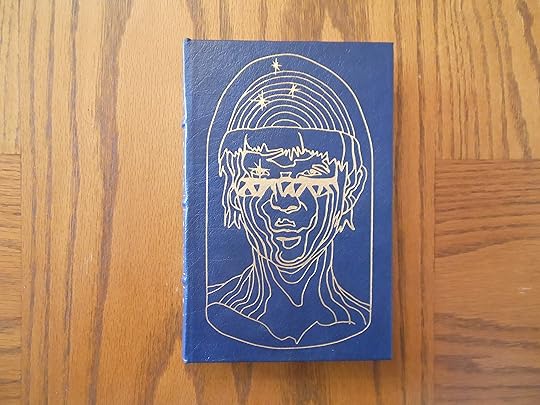
I myself loved this novel. Every single page was a delight — eye-opening insights combined with rich texture and atmosphere. I connected so deeply with The Embedding that I ordered the Vintage Collectible edition: leather-bound, gold-leafed, printed on top-quality paper. I plan to return to this much-overlooked classic again and again.
Speculative fiction doesn’t get any better than this. And to think Ian Watson wrote it in his late twenties. Remarkable.
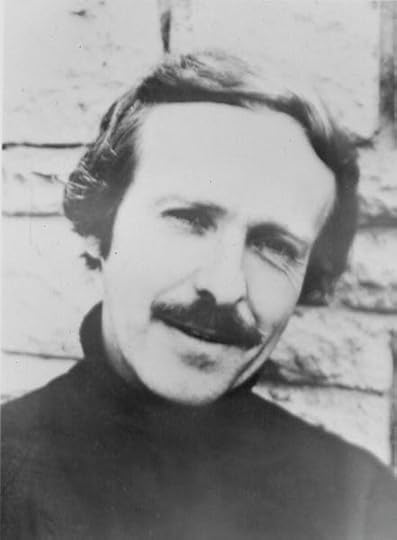
British SF author Ian Watson, born 1943
Comments
Post a Comment