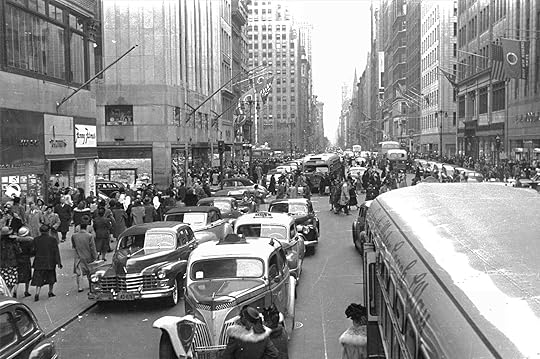
1952 New York City
Oh, how times change. Note how Orville Prescott praises John Marquand, James Cozzens, Dan Wickenden, Rumer Godden, judging them exemplars of literary form, thus great writers. And who does Orville Prescott, THE book reviewer for the NYTimes from 1942 to 1966, think inferior writers since they lack the discipline for proper literary form? Willian Faulkner, John Steinbeck, Ernest Hemingway, John O'Hara, and Elizabeth Bowen.
We can easily spot which group of writers have endured. Sorry, Orville. Your criteria for judging good novels from bad novels has turned out to be ass backward. However, here in 2026, we must admit that we have the advantage of hindsight. Anyway, this should serve as a lesson. We should reserve a degree of humility when passing judgement on writers.
In My Opinion by Orville Prescott ---- Review by C. Hartley Grattan that appeared in the NYTimes back in 1952.
It was very wise of Mr. Prescott to write this discursive book on the fiction of the last decade-American, British and Irish (but not French or Scandinavian). Readers of his contributions four times a week to Books of The Times might have gone on for the proverbial "forever" without making out exactly what he stood for as a critic of fiction. This book is a full disclosure, excellently frank, though marred by the choppiness which is the columnists' occupational disability.
The key to Mr. Prescott's position is his remark, "In this country we have long overvalued vigor and freewheeling, undisciplined talent at the expense of literary form." Mr. Prescott's bias is the opposite: he favors literary form over undisciplined talent. He argues for selectivity, compression, implication, for novels that artfully persuade the reader to suspend disbelief, that engage his interest in characters thoughtfully portrayed, and that have a strong story-line to lure him from the first page to the last. Such novels may be pure entertainment, works of art or interpretations of life, but, as Mr. Prescott rightly remarks, the best are all three. Any devices are good devices if they advance the author's purpose and do not impede the reader's understanding. Novels must communicate ideas and emotions. They must communicate. Preoccupation with method to the point that it becomes content is arid cultism. Above all. novels must be founded in a powerful vision of life, preferably broad gauged. Mr. Prescott fails to quote Conrad, but he certainly agrees with him.
Given this point of view, Mr. Prescott's opinions follow very logically. We understand clearly why he deprecates Faulkner -what he means by the remark which otherwise sounds so persnickety, he “has never bothered to master the rudiments of his craft." Conversely, we understand why he thinks so highly of writers like John Marquand, James Cozzens, Dan Wickenden, Rumer Godden. We know why he deplores most of what John Steinbeck has done since "Grapes of Wrath," regards the later Hemingway productions as poor stuff, dismisses John O'Hara as a minor performer, and just about demotes the London darling Elizabeth Bowen to the low rank of cultist.
THIS reader found himself agreeing with many of Mr. Prescott's evaluations and this time with an understanding of the real reasons behind them, which he had never succeeded in deriving from a conscientious reading of the columns. He thinks many readers will profit likewise; and he thinks that readers coming to Mr. Prescott for the first time will find him a tonic commentator. Yet even after this salutary enlargement of comprehension it still remains a stubborn fact that Mr. Prescott's preoccupation with discipline and measure lead him to undervalue what he says Americans have overvalued-namely, vigor and freewheeling. His book certainly shows how far we have come since Hamilton Wright Mabie conducted our readers into a genteel suburb and left them there, but Mr. Prescott's temperament and critical orientation are such that he should watch out lest Roy Campbell's wonderful rhyme becomes uncomfortable reading for him: the rhyme which mentions the bit and bridle and then rudely asks, “But where's the bloody horse?"
In My Opinion by Orville Prescott ---- Review by C. Hartley Grattan that appeared in the NYTimes back in 1952.
It was very wise of Mr. Prescott to write this discursive book on the fiction of the last decade-American, British and Irish (but not French or Scandinavian). Readers of his contributions four times a week to Books of The Times might have gone on for the proverbial "forever" without making out exactly what he stood for as a critic of fiction. This book is a full disclosure, excellently frank, though marred by the choppiness which is the columnists' occupational disability.
The key to Mr. Prescott's position is his remark, "In this country we have long overvalued vigor and freewheeling, undisciplined talent at the expense of literary form." Mr. Prescott's bias is the opposite: he favors literary form over undisciplined talent. He argues for selectivity, compression, implication, for novels that artfully persuade the reader to suspend disbelief, that engage his interest in characters thoughtfully portrayed, and that have a strong story-line to lure him from the first page to the last. Such novels may be pure entertainment, works of art or interpretations of life, but, as Mr. Prescott rightly remarks, the best are all three. Any devices are good devices if they advance the author's purpose and do not impede the reader's understanding. Novels must communicate ideas and emotions. They must communicate. Preoccupation with method to the point that it becomes content is arid cultism. Above all. novels must be founded in a powerful vision of life, preferably broad gauged. Mr. Prescott fails to quote Conrad, but he certainly agrees with him.
Given this point of view, Mr. Prescott's opinions follow very logically. We understand clearly why he deprecates Faulkner -what he means by the remark which otherwise sounds so persnickety, he “has never bothered to master the rudiments of his craft." Conversely, we understand why he thinks so highly of writers like John Marquand, James Cozzens, Dan Wickenden, Rumer Godden. We know why he deplores most of what John Steinbeck has done since "Grapes of Wrath," regards the later Hemingway productions as poor stuff, dismisses John O'Hara as a minor performer, and just about demotes the London darling Elizabeth Bowen to the low rank of cultist.
THIS reader found himself agreeing with many of Mr. Prescott's evaluations and this time with an understanding of the real reasons behind them, which he had never succeeded in deriving from a conscientious reading of the columns. He thinks many readers will profit likewise; and he thinks that readers coming to Mr. Prescott for the first time will find him a tonic commentator. Yet even after this salutary enlargement of comprehension it still remains a stubborn fact that Mr. Prescott's preoccupation with discipline and measure lead him to undervalue what he says Americans have overvalued-namely, vigor and freewheeling. His book certainly shows how far we have come since Hamilton Wright Mabie conducted our readers into a genteel suburb and left them there, but Mr. Prescott's temperament and critical orientation are such that he should watch out lest Roy Campbell's wonderful rhyme becomes uncomfortable reading for him: the rhyme which mentions the bit and bridle and then rudely asks, “But where's the bloody horse?"
Comments
Post a Comment