"Einstein supposes that a traveler, if he were to venture far enough through space, would eventually return to his point of origin. What, thought, if the traveler were to return not only to the same place, but also to the same time? Or what if he were to return and find the universe altered somehow? I have, for example, privately, considered what one might call a Möbius universe, whose circumnavigation would bring about a reversal of parity. A left-handed glove, tossed at great speed from the earth, would return millions of years later -- or else at the very same moment -- as a right-handed one."
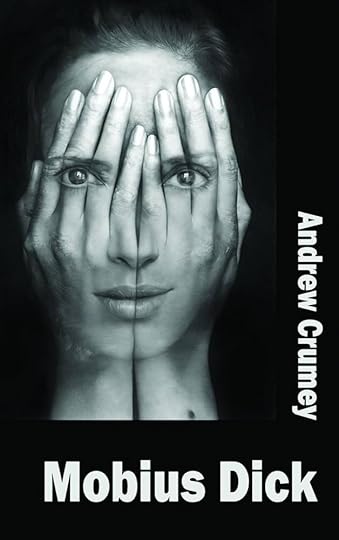
Many are the reflections, such as the one above, sprinkled throughout Mobius Dick, Andrew Crumey's engaging, thought-provoking, highly imaginative novel.
However, perhaps the most important point I can make is this: the Scottish author, who holds a PhD in theoretical physics, is a fantastic storyteller. Each and every narrative in the novel will captivate and keep you eagerly turning the page to find out what happens next. That certainly was my experience.
The narrative threads: German composer Robert Schumann, barely conscious and locked away in a Swiss mental hospital, receives a visit from a highly esteemed lady; in Scotland, Harry Dick struggles to regain his memory after being struck by a car while crossing the road. He's currently under the care of a consultant metaneurologist (this is a science fiction novel); theoretical physicist Erwin Schrödinger travels to a sanatorium in the Swiss Alps to meet a lover and discover the answer to a question in physics that will make him famous; someone claiming to be Heinrich Behring is writing what appears to be a novel, but might simply be a form of therapy; and finally, the main narrative: John Ringer is a professor of physics at a university in Scotland.
Ringer receives a mysterious message on his Q-phone (again, SF), which prompts him to think back to a former lover named Helen. And while attending a lecture on Vicious Cycloids in the Humanities Building, where the speaker discusses Moby-Dick—specifically Ishmael inside the try-pots musing about his soapstone gliding along the cycloid and how all bodies "will descend from any point in precisely the same time"—Ringer's mind wanders back to his first conversation with Helen. They spoke about Thomas Mann and the Schrödinger equation, that is, the fundamental rule of quantum mechanics, which led to considering the extent to which reality is predetermined.
Events move apace for John Ringer until he's meeting with a former student by the name of Don Chambers, who is currently involved in a research project where they need Ringer's help. As he quickly learns, backed by mountains of corporate money, the research centers on what Ringer judges preposterous: harnessing vacuum energy, a breakthrough that could potentially alter the physics of the universe itself. Yikes! What total chaos.
And not long thereafter, things turn very weird for Ringer. What is the cause? Pressed by his financial backers, did Chambers already activate their vacuum energy machine?
An attentive reader will be rewarded by noting the ways in which the various narrative strands braid and bleed into one another. A body sliding along a cycloid curve descends in the same amount of time regardless of its starting point. Does Crumey have his different story lines converge upon a similar destiny? Do the narrative arcs obey a deeper underlying structure?
A Möbius strip has only one side, appears dual but is, in fact, singular, and if we travel along its surface, our orientation flips. How does this apply to narrative? At some point, will a narrator and a character change places? And will any sense of identity fold back upon itself in quite unexpected ways?
Does everyday reality, so-called, appear to follow a coherent, predictable pattern? But what if our world follows the geometry of a Möbius strip, where reality doesn't shatter so much as undergo topological twists—twists that only literature and the world of imagination can reveal?
After reading the final sentence of Mobius Dick, we can ask ourselves: Does the novel ultimately affirm continuity and the need for fixed rules governing the universe? Or, perhaps, does it dissolve anything remotely solid into a dreamlike illusion? If so, then we must face the possibility that the Möbius strip does not merely twist narrative—it may (gulp!) dissolve the distinction between narrative and reader.
If you would care to explore any of these questions, Mobius Dick is your book.

Scottish author Andrew Crumey, born 1961
Comments
Post a Comment