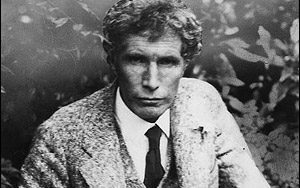
British author John Cowper Powys, 1872-1963
John Cowper Powys's 1916 Suspended Judgements: Essays on Books and Sensations includes essays on more than a dozen authors, from Montaigne, Balzac, and Victor Hugo to Emily Brontë, Joseph Conrad, and Henry James. Each essay is a delight to read. The collection begins with The Art of Discrimination, where Powys sets forth his philosophy of aesthetics, exploring how and why we make literature and the arts part of our lives. It is this introductory essay that will be the focus of my review.
The essay begins: "The world divides itself into people who can discriminate and people who cannot discriminate. This is the ultimate test of sensitiveness; and sensitiveness alone separates us and unites us. We all create, or have created for us by the fatality of our temperament, a unique and individual universe. It is only by bringing into light the most secret and subtle elements of this self-contained system of things that we can find out where our lonely orbits touch."
For Powys, when we discriminate, we're not involved in a cold academic exercise; rather, discrimination is the expression of our emotional and aesthetic sensitivity. Ironically, it is this very sensitivity that simultaneously separates us from the mass of other people and deeply unites us with like-minded individuals. For example, Chad works in an office in Chicago and, unlike his coworkers, doesn't follow the local sports teams, drink beer, play golf, or watch TV and movies. Chad is passionate about Thomas Mann, spending nearly all of his spare time reading The Magic Mountain and Doctor Faustus. For several years, he's been part of two ongoing groups discussing Mann's novels, one in person and one online. Chad is a prime example of someone who, according to Powys, discriminates, and the unique universe he has created for himself is a clear expression of his individuality.
Powys goes on to claim that the essence of great criticism lies in recognizing that the writers and artists we come to love have wrestled with many of the same psychological conflicts we ourselves have faced. The art of discrimination therefore demands that we make a choice: to embrace the literature and art that genuinely nourishes us and discard everything else, regardless of the praise those works may receive from society, critics, or history itself.
This point is central to Powys's philosophy. The ultimate purpose of discrimination is to peel away social and cultural expectations until we arrive at our own authentic responses. Any intellectual authority claiming objective standards of taste—one thinks of the required-reading lists compiled by such figures as Harold Bloom and Mortimer J. Adler—must therefore be viewed with skepticism. Why? Because such standards can never completely account for the visceral, unpredictable, and deeply personal experiences that shape individual taste.
Standards of taste bring to mind David Hume's famous essay. According to the Scottish philosopher, the ideal judge of art possesses refinement, practice, an ability to compare, freedom from prejudice, and good sense. Above all, for Hume, a proper critic is disinterested and unbiased, employing the clear eye of reason with the goal of reaching consensus over time with similarly qualified critics.
Powys arrives at a very different conclusion. By his thinking, the ideal critic is one who is especially interested, biased, and driven by individual temperament and psychology to seek out authors and artists who share his or her passions and wounds. The goal is not to transcend one's personality but to inhabit it more fully—and through one's isolation and unique self-awareness come to lucidity within one's own singular universe. Any attempt to harmonize human tastes into consensus is anathema to Powys.
Powys's radical self-assertion is diametrically opposed to the aesthetics of 19th-century German philosopher Arthur Schopenhauer. For Schopenhauer, literature and art provide a temporary escape from the tyranny of the Will. When we view a great painting or become immersed in a great work of literature, we lose any sense of individuality and become a "pure, will-less subject of knowing," a being released from personal desires, sufferings, and miseries.
Again, Powys views art and literature much differently. Aesthetic experience is not an escape from the self but a deliberate intensification of the self. The ability to discriminate is a valuable gift, one that enables us to explore and deepen our individuality. We are not striving to become "will-less." Quite the contrary, we value authors and artists who are kindred spirits in plumbing the depths of what it means to be uniquely ourselves—our particular passions, weaknesses, and obsessions.
There is, however, one area where Schopenhauer and Powys agree: art should not be reduced to political propaganda or social engineering. Both philosophers regard much of human society as dominated by conformity, illusion, and unthinking habit. The power of art lies not in reinforcing collective assumptions but in awakening individuals to dimensions of experience that everyday social life tends to obscure.
The one 19th-century German philosopher with whom Powys shares a certain affinity is Friedrich Nietzsche. Nietzsche views art and literature as means of self-development, self-assertion, and self-overcoming, including an ecstatic embrace of life in all its horrors and suffering. For Powys, literature and the arts are powerful stimulants that sharpen our individual perspective and deepen our awareness of who we are. Unlike Nietzsche, however, Powys places the emphasis on introspection and the cultivation of individuality rather than on transforming oneself into a force capable of conquering the world.
If you have any interest in literary criticism, aesthetics, or the philosophy of art, I would urge you to explore this collection of John Cowper Powys essays. Perhaps most appropriate for a writer of such distinctive style and vision, I will let Powys have the final word. Here is how he concludes The Art of Discrimination:
"To discriminate, to discriminate endlessly, between types we adore and types we suspect, this is well and wise; but in the long result we are driven, whether it is pleasant to our prejudices or not that it should be so, crushingly to recognise that in the world of human character there are really no types at all; only tragic and lonely figures; figures unable to express what they want of the universe, of us, of themselves; figures that can never, in all the aeons of time, be repeated again; figures in whose obliquities and ambiguities the mysteries of all the laws and all the prophets are transcended!"
Comments
Post a Comment