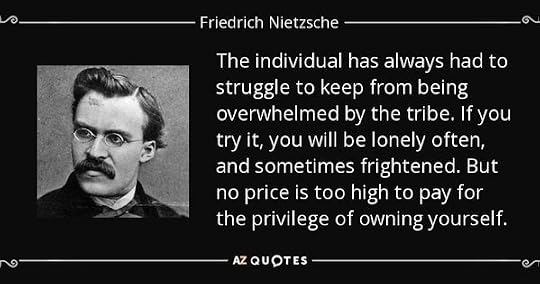
The Dawn of Day is a work by the German philosopher Friedrich Nietzsche that I first encountered fifty years ago and have returned to again and again to mine for its wisdom.
As a way of highlighting the depth of the insights contained herein, I will focus on two quotations, the first taken from the concluding paragraph of the Author's Preface.
"Above all, however, let us say it slowly.... This preface comes late, but not too late: what, after all, do five or six years matter? Such a book, and such a problem, are in no hurry; besides, we are friends of the lento, I and my book. I have not been a philologist in vain—perhaps I am one yet: a teacher of slow reading. I even come to write slowly. At present it is not only my habit, but even my taste—a perverted taste, maybe—to write nothing but what will drive to despair everyone who is 'in a hurry.' For philology is that venerable art which exacts from its followers one thing above all—to step to one side, to leave themselves spare moments, to grow silent, to become slow—the leisurely art of the goldsmith applied to language: an art which must carry out slow, fine work, and attains nothing if not lento. For this very reason philology is now more desirable than ever before; for this very reason it is the highest attraction and incitement in an age of 'work': that is to say, of haste, of unseemly and immoderate hurry-skurry, which is intent upon 'getting things done' at once, even every book, whether old or new. Philology itself, perhaps, will not 'get things done' so hurriedly: it teaches how to read well: i.e. slowly, profoundly, attentively, prudently, with inner thoughts, with the mental doors ajar, with delicate fingers and eyes ... my patient friends, this book appeals only to perfect readers and philologists: learn to read me well!"
When Nietzsche praises lento, he is doing much more than simply encouraging a particular reading technique; he is proposing an entirely different mode of being. Rather than living one's life in constant haste, forever consuming more and more information as quickly as possible, the German philosopher urges us to slow down, exercise patience, and approach life—especially reading—with the eye of a goldsmith.
For the goldsmith, one careless movement can ruin hours of work, and the precious metal itself demands the utmost care. Likewise, words are not to be skimmed over but treated as something precious. More fundamentally, Nietzsche urges us to resist the temptation of premature certainty. Before reaching conclusions, we should patiently examine the hidden histories, assumptions, and psychological motives that shape our judgments.
When reading a novel, for example, we can ask ourselves such questions as these: Why is this image or metaphor being used? Why did the author choose this particular word? How does this passage accord with an earlier scene? What philosophical questions is the author pressing us to consider? What assumptions is the author asking us to question? What hidden history made this idea appear self-evident? What do unfolding events and disclosures reveal about a character's perception and identity?
Nietzsche is definitely not advocating a mechanical, lockstep analysis. Quite the contrary—he is recommending attentiveness, meditative awareness, and receptivity. Thus, we place ourselves in a position to notice nuances, subtle tensions, and implications that hurried reading overlooks. The goal is not simply to finish a book; rather, we would be wise to linger with the work, allowing it to continue provoking reflection long after we have finished the final page. Reading, in Nietzsche's sense, becomes less an act of acquiring information than one of gradually transforming perception.
The second quotation comes from Book III, aphorism 186:
"Business Men. — Your business is your greatest prejudice; it binds you to your locality, your society, and your tastes. Diligent in business but lazy in thought, satisfied with your paltriness and with the cloak of duty concealing this contentment: thus you live, and thus you like your children to be."
I have a personal connection to this Nietzsche aphorism—a very personal connection. As a young man, I was obliged to work in the world of business as a commercial underwriter for a large insurance company, an experience I found nasty and suffocating in the extreme.
How does this specific aphorism connect with the first quotation? Working that nine-to-five job, I was repeatedly pushed and prodded not only to work faster but also to walk faster, talk faster, and eat and drink faster. It was the absolute antithesis of the lento Nietzsche places at the heart of a reflective, aesthetically attuned way of life. The faster we move, the less we notice, the less we absorb. And the less we notice and absorb, the more superficial and narrow our understanding becomes. Life is reduced to a rat race in which the treadmill is set to high speed.
As I quickly discovered, the corporate culture surrounding me regarded philosophy, literature, and the fine arts as distractions from what truly mattered. One way to minimize the threat was to ensure that those around you—family, friends, and associates—placed ultimate value on speed, production, and conspicuous consumption, fueled by TV stupor, pills, and booze.
In an age that prizes speed, distraction, and instant opinion, Nietzsche's celebration of lento feels more relevant than ever. More than fifty years after I first encountered The Dawn of Day, I continue to return to it, finding new depths with every reading. Some books are meant to be finished. This is one to live with.

Comments
Post a Comment