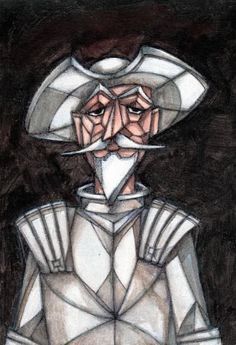
A Problem by Jorge Luis Borges captures in a few short paragraphs a quartet of possible responses when Don Quixote discovers that he has killed a man.
They are, briefly: 1) since Don Quixote believes he has been conducting an unending battle with sorcerers and giants, his killing a man is, as they say, all in a day's work; 2) the psychological trauma of the killing shatters any illusions or delusions Don Quixote might have, forcing him to face the bare, existential reality of his actions; 3) Don Quixote expands and enriches his illusory world by inventing a magical justification for why this man is now dead and covered in blood; 4) there is no real blood, no real dead man, and not even a real Don Quixote, since all of what he experiences is a colossal illusion.
It is possibility number three that I find most distinctly Borgesian and the most richly fascinating. Thus, I will focus on this alternative, calling upon Argentine author Rodrigo Fresán to provide additional insight into why humanity relies so deeply on narrative inventions.
As Fresán articulates in his massive novel, The Invented Part, reality for his main character, The Writer, is filled with the raw, messy chaos of everyday life. This reality includes trauma from a boyhood spent with extremely neurotic parents whose behavior borders on madness; a sister, Penelope—referred to as The Mad Sister—who is manic, restless, intrusive, and overly possessive; and the overwhelming burden of his own aging body and the prospect of death.
Faced with this existential overwhelm, what does The Writer do? He immerses himself in literature, both as a reader and a writer. Coupled with a powerful imagination, this immersion allows him to rewrite his past and modify the painful aspects of his life so that he can thrive as a creative artist.
Pivoting back to the Borges tale, we can see this is precisely how Don Quixote handles the reality of the victim lying before him covered in blood—a killing that threatens to destroy his identity as a heroic knight. Rather than succumbing to despair, Quixote summons his own "invented part." He constructs a magical, mythical parallel reality: a world where his violent action is transformed into a necessary piece of cosmic destiny.
Reflecting on our own lives, isn't this exactly how we handle the messy, muddy chaos of our past, present, and future? We are all prone to creating our own “invented part,” becoming the hidden artists who rewrite our personal narratives not just to survive day to day, but to truly flourish. We might not be recognized novelists or errant knights in armor, but the corresponding parallel realities we invent can be equally fantastic.
Comments
Post a Comment