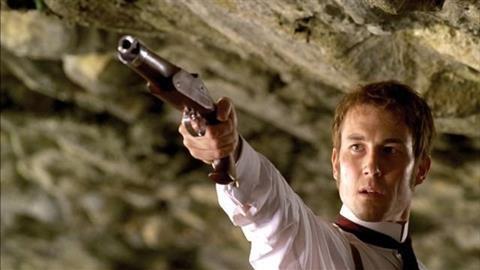
Still from the 2010 film based on the novella
By my reckoning, The Duel by Anton Chekhov counts as one of the greatest novellas ever written—a work I first encountered back in college and a work I've enjoyed reading (and listening to via the audiobook) again and again.
Since Chekhov's novella has prompted a good number of perceptive online reviews, I will take a fresh approach and link my comments to a few memorable lines that continue to resonate with me. Spoiler alert: in order to address several key philosophic dimensions, I'm obliged to write about the novella's unfolding plot and concluding scene.
The tale takes place in a small town on the edge of the Black Sea in the Caucasus (around present-day Georgia), 1,200 miles south of Saint Petersburg. The main characters are:
Ivan Andreitch Laevsky: A civil service clerk, and a weak-willed and disillusioned slacker who spends most of his time idling away—drinking, carousing, playing cards, and piling up debts.
Nadezhda Fyodorovna: Laevsky's mistress. She left her husband to flee south with Laevsky, and is a beautiful young lady inclined to romantic dreams.
Von Koren: A zoologist, and a man of rigid standards who firmly upholds natural selection, social Darwinism, and rationalism. He is Laevsky's prime rival.
Samoylenko: A military doctor, and a warm-hearted, hospitable, peace-loving man.
"With his big cropped head, short neck, his red face, his big nose, his shaggy black eyebrows and grey whiskers, his stout puffy figure and his hoarse military bass, this Samoylenko made on every newcomer the unpleasant impression of a gruff bully; but two or three days after making his acquaintance, one began to think his face extraordinarily good-natured, kind, and even handsome."
Anton Chekhov is universally judged as a master of description, especially regarding his short character sketches. We're given a clear, colorful picture of each player in the unfolding drama, beginning with Samoylenko.
“It’s the Germans who have ruined you, brother! Yes! The Germans!”
Von Koren passes harsh judgment on slackers like Laevsky, continually proclaiming that such lazy weaklings should be either shot or, at the very least, forced into penal service in Siberia where they can provide some benefit to society. Samoylenko tells Von Koren the Germans have infected his thinking, taking away his love for his fellow man. I studied a lot of 19th-century German philosophy in college—such thinkers as Hegel, Marx, Feuerbach, Schopenhauer, and Nietzsche—so I have a good sense of what Samoylenko is driving at here.
Further on, prior to challenging Laevsky to a duel, when asked if he, Von Koren, could really shoot Ivan Andreitch Laevsky, he replies: "With a steady hand."
For me, this curt answer underscores Von Koren as an unflinching rationalist—a scientist who has little use for anything that doesn't accord with his highly dogmatic views of human strength and survival. In particular, it highlights how he believes an ironclad morality and strict social mores prove critical to the improvement of civilization.
"The laugh grew shriller and shriller, and became something like the bark of a lap-dog. Laevsky tried to get up from the table, but his legs would not obey him and his right hand was strangely, without his volition, dancing on the table, convulsively clutching and crumpling up the bits of paper. He saw looks of wonder, Samoylenko’s grave, frightened face, and the eyes of the zoologist full of cold irony and disgust, and realised that he was in hysterics."
Laevsky caught in the grip of hysterics after reading a scathing, unsigned note (probably penned by Von Koren) is among the most memorable scenes. We as readers can imagine what Von Koren, his eyes filled with cold irony and disgust, must think when this weakling, this slacker and silly chatterbox, breaks down in a state of uncontrollable hysterics.
Three months following the dramatic events in the novella, including the duel between Laevsky and Von Koren, the zoologist is about to set off on his years-long scientific expedition.
We read Chekhov's words: As they passed the little house with three windows, into which Laevsky had moved soon after the duel, Von Koren could not resist peeping in at the window. Laevsky was sitting, writing, bent over the table, with his back to the window.
“I wonder at him!” said the zoologist softly. “What a screw he has put on himself!”
“Yes, one may well wonder,” said Samoylenko. “He sits from morning till night, he’s always at work. He works to pay off his debts. And he lives, brother, worse than a beggar!”
Ah, so Laevsky has transformed himself: he married Nadezhda Fyodorovna and does nothing but work at his desk copying government documents. No gabbing about, no playing cards, no drinking, and no piling up debts. He is the perfect, productive, upright citizen.
At this point, again we read Chekhov's words: The zoologist took Samoylenko’s sleeve and went on with emotion in his voice: “You tell him and his wife that when I went away I was full of admiration for them and wished them all happiness . . . and I beg him, if he can, not to remember evil against me. He knows me. He knows that if I could have foreseen this change, then I might have become his best friend.”
Shifting to the philosophic, I wrote a review of another classic Chekhov tale: The Black Monk. In that tale, a scholar by the name of Kovrin encounters visions of a Black Monk who tells him he is a superior man, capable of spiritual transformation and becoming creative in the most magnificent ways.
And what is his wife and lover Tánya's reaction when Kovrin tells her the Black Monk has spoken to him? Predictably, as a staunch representative of the status quo, she thinks he's sick and must seek out medical treatment to be cured.
Sidebar: Nowadays, the Tányas of the world, both male and female, spend most of their lives eating crap food, drinking soda and booze, all the while sitting on their fat asses in front of the idiot box, aka the boob tube, aka the TV. “Come on, Kovrin, be normal like us!”
And further on in the tale, when Kovrin does become “normal,” he says to his little lovely, “Now I have become rational and solid, just like the rest of the world. I am a mediocrity, and it is tiresome for me to live.... Oh, how cruelly... how cruelly you have treated me! I had hallucinations ... but what harm did that cause to anyone? I ask you what harm?”
Ha! Kovrin, my boy, your visions of the Black Monk don't harm anybody. But—and here's the kicker—your visions of the Black Monk threaten other people's worldview, their secure little version of life.
I'm reminded of Schopenhauer's words: "Whoever expects to see devils go through the world with horns and fools with jingling bells will always be their prey or plaything." However, there's another force acting in society, in many ways more insidious—all those holders of the status quo, executing groupthink with a vengeance. Anybody who seeks to follow their visions, their creative fires, and their call to be something more than humdrum and mediocre—beware! The Tányas of the world are many.
Turning to The Duel, we can detect the way Von Koren shares common ground with Tánya—he experiences a profound discomfort when someone steps outside their assigned, conventional role. Von Koren judges people with exactly the same rigid desire for containment but adds a conceptual layer: social Darwinism and scientific progress. For Von Koren, everything must fit into his tidy, cold, rational grid. Thus, a human being is either a productive asset to the state or a piece of societal "refuse" that needs to be either eliminated, or, at least, put in chains and forced to perform manual labor.
I will conclude with a slight modification of my Black Monk review: Anybody who seeks to follow their visions, their creative fires, and their call to be something more than humdrum and mediocre—beware! The Von Korens of the world are many.
Comments
Post a Comment