
Murilo Rubião has quickly become one of my favorite Latin American authors, an author who takes his place in the grand tradition of writers like Jorge Luis Borges, Julio Cortázar, and his fellow countryman, Moacyr Scliar.
As a way of sharing the impossible magic of his writing, I will focus on a single story from this collection, The Ex-Magician and Other Stories. Spoiler Alert: To do a measure of literary justice here, I will cover the tale from beginning to end.
THE MAN IN THE GRAY CAP
“It was the fault of the man in the gray cap.”
So begins this extraordinary six-page tale by Brazilian master of the craft Murilo Rubião.
Roderico, the first-person narrator, sets the stage: his street is the quietest in the city, with children outside playing, singing in a circle, and running back and forth between trees—a peaceful, harmonious neighborhood.
Then it begins: trucks unload a tremendous number of heavy crates in front of the enormous building across the street. Roderico suggests to his brother Artur that perhaps the building has been rented out to a commercial establishment to be used as a warehouse. But, no, an agitated Artur points out that the houses on the street have started shaking. Not only that—the sky is filled with perfect little squares alternating in gray and white.
Later in the week, Roderico reports that their new neighbor has arrived. Through Roderico, Murilo Rubião provides a detailed character sketch: “Covering his head, he wore a (gray and white) checkered cap and, between his dark teeth, sported a curved pipe. His eyes were sunken, his baggy clothes overwhelming a tiny, almost skeletal frame.”
Unlike Roderico, with his mocking attitude toward such a grotesque figure, Artur becomes increasingly upset and says, “That man caused the checkered sky, but it won't be long before he disappears.”
Artur isn't the only one who's upset. The street's residents become perplexed since their new neighbor, an old bachelor, is never seen leaving the house; rather, every day, at exactly five o'clock in the afternoon, he steps out onto the front porch, never without his gray cap. He simply takes a few puffs on his curved pipe and disappears inside.
Artur spends the entire day spying on the man with the gray cap, anticipating that he might step out prior to five o'clock. A thrilled Artur tells his brother that he has discovered his name is Anatólio. And every day, at five, when Anatólio does step out, Artur becomes even more excited and says, “Look, Roderico, he's thinner than yesterday!” After a few days, Roderico replies, “Impossible. That skinny devil hasn't anything left to lose!” Artur retorts, “Well, he's losing it.”
Then, the added drama: a car pulls up and out steps a lovely girl. Suitcase in hand, she walks up and uses a key to open the front door. Artur imagines many strange possibilities concerning the relationship between this young girl and the old bachelor.
And three months later, the girl walks out, dragging her suitcase, and vanishes around the corner.
Artur repeats again and again, “He keeps getting thinner.” Meanwhile, Roderico loses his usual confidence, and his nerves become increasingly frazzled—not so much because of Anatólio's chronic leanness, but because he detects a change in his brother: his brows have begun to furrow, and his cheeks have become hollow. So, as a way of proving to Artur that there's nothing abnormal about the bachelor, he begins spying on the man with the gray cap himself. “He always stepped out at the appointed hour. His eyes distracted, the hat swamping his head, he sometimes cracked a disdainful smile.”
Roderico can't take his eyes off the man in the gray cap—his scrawniness mesmerizes him. Then, the impossible. Artur declares: “He's becoming transparent.” Roderico becomes horrified. Looking closely, he can see right through the old bachelor.
The next day, Artur, who himself is also growing thinner, exclaims, “Look! He's so thin now, there's nothing but an outline. He'll disappear tomorrow, completely!”
And when tomorrow does arrive, an even thinner man steps out—his skull diminished, the gray cap so baggy on his head that it slides down over his eyes. Suddenly, he has a spasm and emits a jet of fire, which sweeps over the street. The brothers watch as Anatólio has a violent contraction and vomits again, allowing some of the incandescent slobber to trickle back down his throat and ignite himself. All that remains is his head, covered by the gray cap. And his pipe, extinguished on the ground.
The horror takes a more personal turn. Roderico can hardly believe his eyes: his brother has diminished—he's scarcely more than a few inches tall. Roderico takes Artur in his fingers, but after a few seconds, his brother turns into a tiny black ball rolling around in his palm.
And here Rubião's six-page tale begins opening some surprisingly profound philosophical questions:
THE BOUNDARIES OF THE POSSIBLE.
When reading fiction, what is our expectation? If we're reading a fairy tale, we don't object when a dragon appears outside the princess's castle. Why? Because a fairy tale comes with long-established conventions and expectations.
Rubião does something much more playful: he sets the framework for a work of social realism, then begins violating social realist conventions. He seems to ask readers more than: Is this believable? His question expands to: What does this story teach us to consider possible within its fictional world? And Rubião changes the answer as we progress through the story.
Initially, the gray and white checkered sky appears early, right alongside crates, houses, brothers, and neighbors. But then, toward the end, the fantastic unfurls, one jaw-dropping transformation after another.
THE OPENNESS OF MEANING
And what is our expectation when reading a review of this story? Would anyone expect that I, as reviewer, would provide an explanation or interpretation of the fantastic elements? If so, I'm afraid that isn't my style, not even close. For me, it is much wiser to allow each reader to ponder this story—a story containing an abundance of possible meanings—on its own terms. More generally, I think the search for an exclusive or definitive meaning, particularly in imaginative literature, is vastly overrated.
THE COMPULSIVE INTERPRETER
Back to the story. Brother Artur desperately seeks explanations. He watches. He listens. He studies. He anticipates. He's elated to discover the man's name. He tracks how his body thins. He predicts his disappearance. In other words: at every point, Artur interprets. This constant interpreting makes Artur an amusing cautionary figure for the reader—and, most directly, for the literary critic/reviewer.
And Rubião might be having a good laugh at critics and reviewers of his fiction who metaphorically stand next to Artur, casting their sharp critical eyes on the man in the gray cap and asking questions like: What does the transparency symbolize? Why the gray cap and curved pipe? What's that young girl all about? And such an ending! What was the author thinking when he turned Artur into a tiny black ball?
Interpreting, indeed! How willing are we to allow the magic of the fantastic to remain beyond our categories of logic and reason?
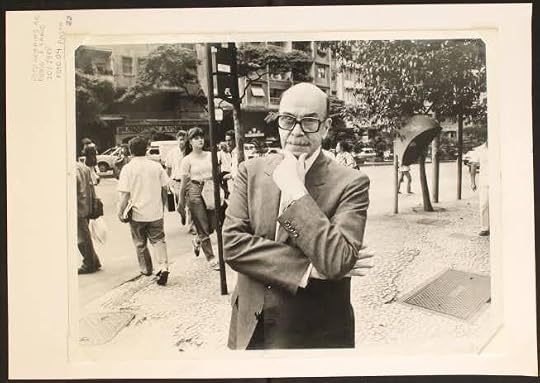
Brazilian short story writer Murilo Rubião, 1916-1991
Comments
Post a Comment