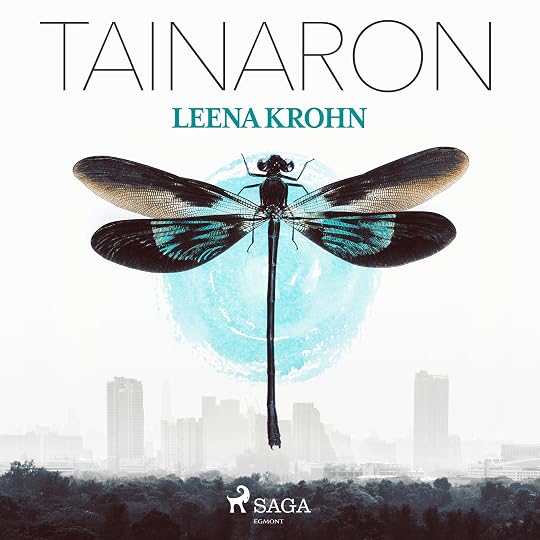
My absolute favorite authors can fire my imagination in the most creative, explosive, unexpected ways—Philip K. Dick, Christopher Priest, Michal Ajvaz, Italo Calvino, Zoran Živković, Michael Cisco, and Julio Cortázar, to name several. I can now add Finland's Leena Krohn to the list. And great news: not only is Tainaron included in Collected Fiction, published by Cheeky Frawg Books, but five other novels by this outstanding author are included as well. I'm excited at the prospect of sharing reviews of each of her novels.
Tainaron is extraordinary—sheer dynamite to detonate and expand the mind, a gem from Finland that's especially suited for fans of any of the authors noted above. Here's one suggestion I would make to enhance the reader's aesthetic and literary experience: suspend the urge to be overly heady; rather, allow the strangeness of Tainaron to disclose itself in all its intricate detail, flooding your senses and feelings. Experienced in this way, the peculiar insects, settings, and seemingly impossible situations in Tainaron's highly expressive world will catch you by surprise, and you'll find yourself eagerly turning the pages.
The way Leena Krohn frames her tale is deceptively simple. The unnamed narrator visits the city of Tainaron. I'll give the narrator a good Finnish girl's name—Tuuli. Over the course of several months, Tuuli sits at her writing desk and composes thirty letters to her friend back home, each letter forming a short chapter, a luminous tessera in Krohn's mosaic novel.
I have fallen deeply in love with Tainaron, the city and its inhabitants pulsing with a unique vibration in each of Tuuli's thirty letters. To share slices of the novel's special rasa, from its philosophic depth to its sensual richness and stunning strangeness, I will focus on four of these letters.
THE FIRST LETTER
Right at the outset, Tuuli provides her friend (and us as readers) with a vivid, lavish account of a colossal Tainaron garden and its adjoining meadow, where some flowers grow underground and some have stalks as strong as the trunks of young birch trees, a garden with wildflowers six feet tall, some with corollas as broad as a human face, some so large you can step into them, a garden containing flowers that open so wide their honey-patterns are precise and clear, a garden buzzing with symbiosis between insects and flowers—“fervent activity and a theatre of war. But everything serves just one purpose: immortality . . . the selfishness of each individual works for the happiness of all.” Meanwhile, one Tainaronian waves all his legs and whines earnestly: “This way, ladies and gentlemen, please don't be shy!” Oh, yes, welcome to Tainaron—where the inhabitants are insects, some as tall as the tallest of men, and many with the ability to speak perfect English (a special shout-out to translator Hildi Hawkins).
A gent by the name of Longhorn serves as Tuuli's guide during her time in Tainaron. However, a crisis is at hand. A little bit of a man is struggling, stuck in a flower's funnel-like stigma. Ah, a flytrap. Longhorn scoots over on all his legs and pulls the victim out. Oh, yes, Longhorn is a tall, handsome, articulate longhorn beetle, a helpful friend to Tuuli at every quizzical, curious turn.
A final note worthy of mention: Although this garden is filled with “equally treacherous plants” and there is that time Tuuli nearly loses her life in what proves to be a perilous sand formation at the ocean's edge, at no point does she mention being threatened or subjected to violence by the insects themselves.
THE NINTH LETTER
Here Tuuli descends into the Hades of Tainaron, led all the way down the many steps by a funeral director, an imposing man with a spectacularly colored chest ranging from green to lemon, “while the knobs of his antennae were as yellow as clementines.” Tuuli recognizes that she has spoken of this huge, stinking subterranean chamber as Hades and a sepulchre, but “in reality the space in which I found myself served the opposite purpose: it was a dining room and a nursery. Those who toiled here were not merely workers; they were also, above all, mothers.”
And what is Tuuli's philosophic reflection after her time in Tainaron's underworld? She is clear: “Truly, it is a laboratory compared to which even the greatest achievements of the alchemists are put to shame; but all that is done there is what the earth achieves every year when it builds a new spring from and on which rotted and died in the autumn.”
We can likewise reflect on our visit not only to Tainaron's fetid underworld but also to each of the strange yet alluring tesserae forming Krohn's literary mosaic: Where on the wheel of life is there love and growth without a stinging shard of grief and death? So, in this sense, how fundamentally different is a world where men and women possess the familiar head, arms, and legs from one, like Tainaron, where a man sports a rainbow of colors along with yellow antennae and six very functional legs?
THE THIRTEENTH LETTER
Tuuli wakes from a nightmare and muses: “My unbelief had saved me, but the poor creature who believes that everything is true is the victim of his dreams.” How closely is Leena Krohn aligned with Tuuli here? If the connection is one of liberation, my sense is that they are very closely aligned, particularly when I read the concluding short paragraph of this letter: “Oh, I have something wider than a prairie, wider than Oceanos. I do not know where to put it, to whom to present it. I cannot show it; I cannot use it. It is too wide for this city; one life is too small for it. No one needs it, but today it has me flying and singing.”
Oh, Tuuli; oh, Leena, I can hear your dazzling singing coming from the sky's clear light—a song reminding me that I have the capacity to experience the limitless possibilities of the fires of imagination without becoming imprisoned by their creations.
THE TWENTY-THIRD LETTER
Tuuli tells her friend there is a gentleman who lives on the same block as she does, a tall, thin gentleman who has a most unusual habit: he hangs upside down from his balcony for a number of hours every single day. Initially, Tuuli thinks he must be in need of help, but Longhorn notes that this gentleman has assumed his pose of his own free will and, besides, it isn't wise to interfere in other people's lives.
Day after day, Tuuli sees him hanging there, limp and almost floating, and imagines he is either asleep or meditating. The upside-down gentleman appears so incredibly calm, even when a fire brigade roars past, siren wailing. The bright green Dangler looks so much like a living leaf. Tuuli imagines that he is dreaming, an endless leaf-green dream.
I must admit, of all the characters in Tainaron, the Dangler is my favorite. Why? For me, the Dangler is nothing less than an accomplished yogi, one who, in stillness and silence, takes the upside-down posture as a way of stepping out of ordinary sensory habits to perceive the city—and the self—from an entirely different angle.
In this way, the Dangler can be taken as an emblem of how Tainaron itself asks to be read: not as a work to be rushed through, but as a work of imaginative literature to be absorbed slowly and reflectively—even if you are reading right side up rather than upside down.
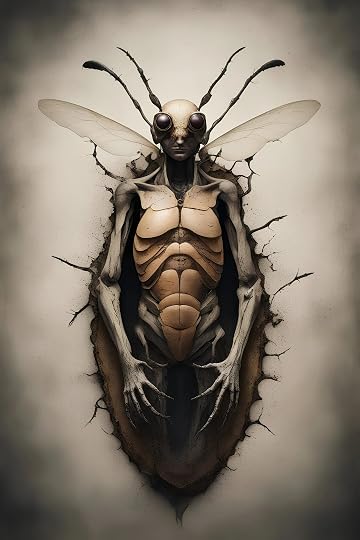

Leena Krohn from Finland, born 1947
Comments
Post a Comment