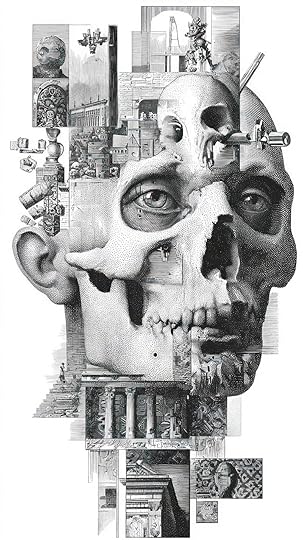
The Golem is the second volume of Michael Cisco’s two-book sequence, The San Veneficio Canon. Readers should certainly begin with The Divinity Student, the opening installment, before venturing into The Golem. Together, the two novels stand as masterworks of what is often called “Weird Fiction.”
In the opening paragraphs of the novel's Prologue, it becomes immediately clear that Cisco intends to unsettle the reader with a frightening, vertiginous blending of time and space. The Divinity Student is “speeding down a tunnel, hands thrown up in shock and dismay: it’s time again, and space again.”
We’re first presented with a kind of theatrical set: a white room, a mirror mounted on the inside of a door, milky light, snow drifting across thick carpets. Then everything fractures. “In the mirror there’s a collapsed figure, hanging its head, body petrifies into grey film . . . Then, miles beneath the white room, a dark doorless black room embedded in rock, lined with control consoles, hands and eyes fluttering like bats above illuminated displays.”
The Divinity Student feels an endless shift of equilibrium and his limbs stretch and stiffen in protest, but his body continues moving through increments of space. He falls, spinning. Is this an initiation rite, the Divinity Student reduced to a plaything of powerful, unnamed forces? Possibly. It all echoes his earlier rebirth as a being stuffed with random pages of text, a world in which control, embodiment, and knowledge are radically unstable.
Much of the work’s uniqueness lies in the author’s language—clinical and concise, yet combined with colorful, occasionally baroque descriptions, similes, and metaphors. And since I’m in complete agreement with Stephen King, who has stated more than once that reviewers often give away far too much, I’ll shift to spotlighting a number of features of Cisco's highly unique, off-the-wall, funky, flakey novel.
DEMONIC DARKNESS IN THE PALM OF YOUR HAND
“No moon tonight; the desert exhales powdery ropes of darkness, as glacially indifferent and absent as the sky, with a positive substance of darkness.” This statement sets the tone for the entire novel: darkness is not the absence of light but an active, tangible force, a material substance that can be manipulated by a wizard, magician, alchemist—or golem. In the city of San Veneficio, concepts and abstractions, especially those of the nefarious variety, frequently become as concrete and real as a table or chair.
THE EYES OF GIANTS ARE UPON YOU ALL THE LIVELONG NIGHT
“Out in the desert giant monitor lizards, the size of horses, have emerged from their daytime hiding places to watch the city as they do every night, standing completely still, the city lights reflected in their enormous eyes.” Surely one of the most memorable and eerie aspects of San Veneficio: at night these giant green lizards, as large as Bentley sedans, encircle the city and keep watch as if they were a battalion of hired guards.
LAUREL AND HARDY MEET HIERONYMUS BOSCH
Two detectives, Pracke and Kipe, following their boss’s orders, drive out to a graveyard and exhume a coffin containing none other than the Divinity Student. What might have been a scene of ghastly resurrection instead veers into slapstick. The Divinity Student sits up, climbs out of his coffin, and marches off, only for the hapless detectives to catch him and haul him toward their car. “Under his coat he feels like a bag of sticks, his joints poking out in all directions, his flesh like wet cardboard. He coughs up a few more bits of paper with a retching sound and goes limp.”
UGLY, UGLY, UGLY CITY
“Of course there is a circus in San Veneficio—open warehouses with dirt floors and straw on the ground. The nightly audience sits hushed and excited in fleets of folding chairs on graduated risers, their backs to the open air.” And, naturally, we are treated to many details about San Veneficio, one of the ugliest cities ever imagined. And who occupies the center ring tonight? Teo. Readers will remember him as the Divinity Student’s assistant during the period when the bookish student was tasked with gathering corpses to extract their memories. Here, Teo dazzles the crowd as a knife-thrower, a skill that will prove valuable in his further adventures within the city.
LYRICAL INTERLUDE
“Christine Dalman, the Magician, moves to the center of the stage seeping autumn perfume, her serenely concentrated face suspended in tissues of faint red light, her hands float at the ends of rustling red silk sleeves, pale and bright against the carmine draperies behind her.” Meet the lovely lady taking a prominent place within Cisco's otherwise freakish, ugly, occult San Veneficio. She might not be the perfect lover for the Divinity Student, the Golem, or anyone else, but Christine certainly counterbalances all of the grotesquery and brutality laced through many of the novel's scenes.
DOUBLE YOUR PAIN, DOUBLE YOUR FUN
“Now the head, a perfect likeness, is lowered and joined to the body, the spinners sewing crazily, the surgical silk singing through the runners. The Divinity Student watches the body assemble itself dreamily, nodding back and forth on his stool. The head is attached, the body is complete." Cisco creates original twists and torques to the traditional doppelgänger tale.
Again, it can't be stressed enough, if you are a fan of weird fiction by writers like Jeff VanderMeer, China Miéville, Haruki Murakami, or Thomas Ligotti, you'll count Michael Cisco's San Veneficio Canon among your favorites.

American author and Deleuzian academic Michael Cisco, born 1970
Comments
Post a Comment